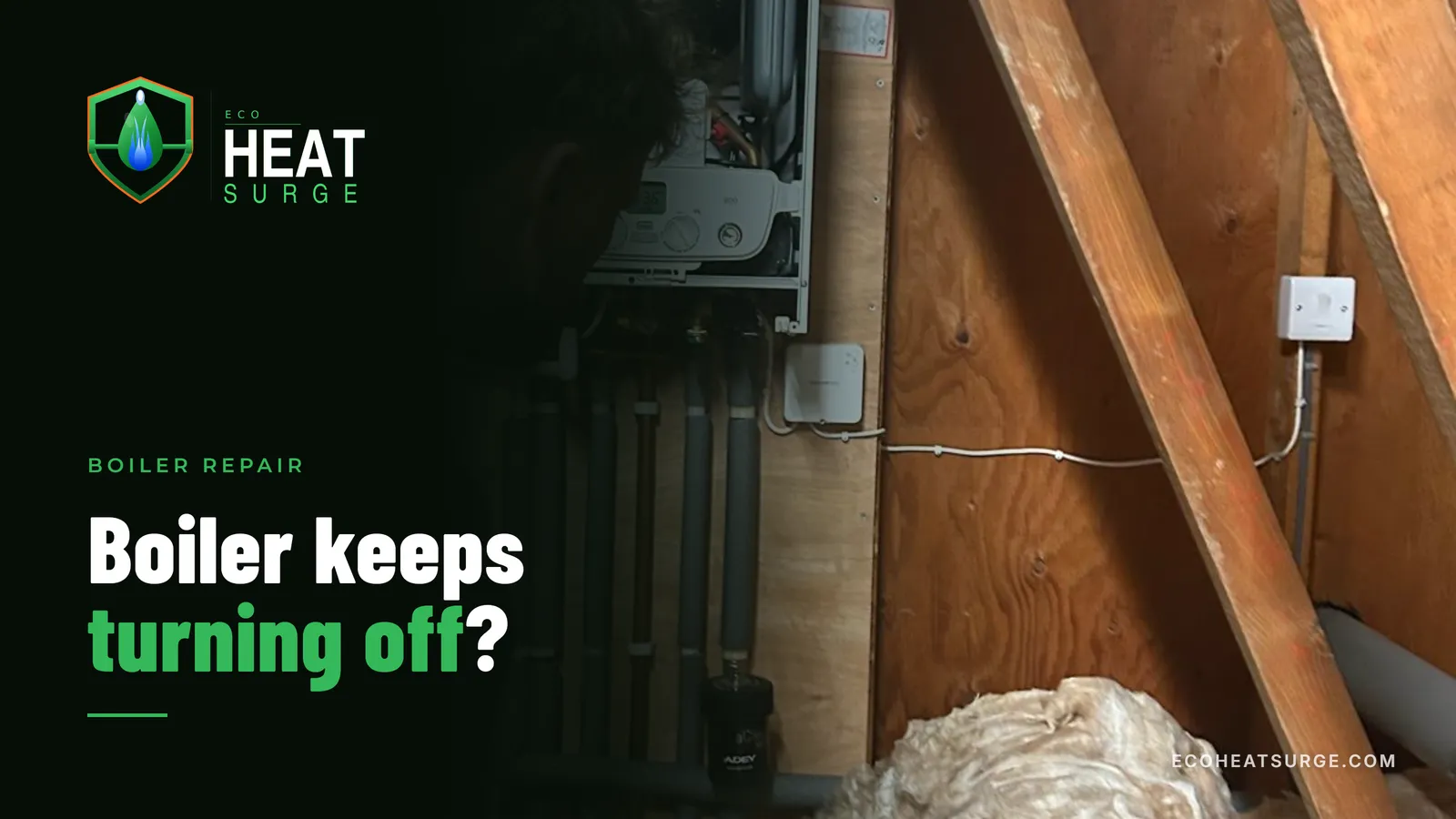
You hear it fire up, the radiators start to warm, and then a few minutes later there's a click and everything goes quiet. Sometimes it comes back on by itself. Sometimes it sits there with a code on the screen until you press reset, and an hour later it's done it again. When your boiler keeps turning off like this, it's either shutting down on purpose because it's spotted a problem, or something keeps cutting its run short, so it fires, rests and fires again all day.
You can usually tell those apart in ten minutes, because a boiler that throws up a code is saying something quite different from one that keeps switching itself back on. I've put the checks below with the cheapest and easiest first, and I'll tell you plainly when it's time to down tools and hand it to Adam or me.
There's one thing that comes before all of this, mind. A smell of gas changes everything. Leave the boiler completely alone and open up the windows and doors, keeping away from light switches, plugs and anything that sparks or burns. If the meter's somewhere you can reach easily, and not down in a cellar, shut the gas off there. Then get yourself outside and ring the free gas emergency line on 0800 111 999.
Lockout or short cycling? Working out why your boiler keeps turning off
Stand by the boiler for a bit and watch what it does when it stops.
If it goes off and puts a fault code or a flashing light on the display, and won't come back until you press reset, that's a lockout. The boiler has noticed something it doesn't like (low pressure, a blocked pipe, a flame that won't stay lit) and it's shut itself down on purpose. That's a safety feature doing its job, even if it doesn't feel like it at seven in the morning.
If it fires, runs for a few minutes, stops with no code, then fires again shortly after, over and over, that's what engineers call short cycling. Nothing has "failed" as such. The boiler just keeps getting told to stop too early, and the answer is usually somewhere in your controls, your radiators or the water going round the system.
Here's a rough guide to what each pattern tends to point at.
| What you're seeing | What's usually behind it | Where to start |
|---|---|---|
| Fault code, pressure gauge reading low | Water has escaped from the system | Top up the pressure, then watch whether it drops again |
| Fault code on a frosty morning | Frozen condensate pipe outside | Thaw the pipe (see below) |
| Fault code, gauge looks fine, it won't stay lit | Gas supply, ignition or flame sensing | Check your other gas appliances, then call an engineer |
| No code, stops and starts every few minutes | Thermostat, closed radiator valves, air or sludge | The checks further down |
| Bangs, rumbles or kettles before it cuts out | Overheating, often from scale or sludge | Call an engineer |
If the screen is showing a code
Low pressure
This is the one I'd look at first, because it's common and it's free to fix. Check the pressure gauge, which is usually a small dial near the bottom of the boiler, though some newer ones show it as a number on the screen. Glow-worm's advice on boilers that keep turning off says that below 1 bar you'll probably need to top the system up, back to around 1.5 bar, and it points out that low pressure ranks among the commonest reasons a combi shuts itself down. Your boiler's manual shows you where the filling loop is and how to use it.
Topping up once is fine. If you're reaching for that filling loop every week or so, the water is going somewhere, and that's a fault to find rather than a chore to keep doing. I've written a whole piece on why a boiler keeps losing pressure if that sounds like yours.
A frozen condensate pipe
If it's been properly cold overnight and the boiler is locking out with a code, look outside for a thin plastic pipe leaving the wall near the boiler and heading down to a drain. Modern boilers make a bit of water as they burn gas, and that pipe carries it away. When it freezes, the water backs up and the boiler stops itself before that water can cause any trouble. It's most likely on the first proper frost, especially where the pipe runs a long way outside with no lagging on it, and our guide to thawing a frozen condensate pipe walks you through clearing it safely.
It tries to light and gives up
If the pressure's fine and the pipe's clear but it still can't keep a flame going, check whether your hob lights. If it doesn't either, the problem is the gas supply rather than the boiler, and on a prepayment meter it's worth checking you've still got credit. If the hob's fine, the fault is inside the boiler, somewhere around the ignition or the part that checks a flame is actually there. That's work for a Gas Safe engineer, so leave the casing on.
When it fires, runs a little while and stops
This is the short cycling pattern, and it's where most of the things you can sort yourself are hiding.
Your thermostat is fooling it
The boiler only runs while something is asking for heat. If the room thermostat sits in a spot that warms up quickly, above a radiator, in the sun, or right next to the kitchen, it can decide the house is warm long before it is. Nudge it up by three or four degrees and see whether the boiler stays on longer. If the thermostat runs on batteries, put new ones in, because a weak battery can make a wireless one drop its signal. If you've only just fitted a smart thermostat and this started straight after, mention it when you ring, so whoever comes out knows to check how it's been set up.
The water can't get round fast enough
A boiler needs to push its heat out into the radiators. If most of them are turned off, or the thermostatic valves on them are wound right down, the heat has nowhere to go. The water in the boiler gets hot quickly, the boiler thinks it's done and switches off, then cools down and starts again. Open your radiator valves back up, especially in rooms you've been "saving" heat in, and see if it settles.
Air does something similar. If some radiators are cold at the top, bleed them, then check the pressure again afterwards because bleeding lets a little water out. A radiator that's warm along the top but stays cool lower down is a different story, and usually means sludge, which is the next thing on the list.
Sludge and limescale
Over the years, black sludge settles in radiators and pipes, and in hard water areas scale builds up inside the boiler itself. Both slow the water down and make the boiler run hotter than it should, so it cuts out to protect itself. You'll often hear it before you see it: rumbling, cracking or a sound like a kettle just before it switches off. There's nothing to fix yourself here. It needs an engineer to clean the system out. Sometimes that's a full power flush and sometimes cleaning the filter is enough, and we'll work out which before we quote you for anything.
The boiler's simply too big for the house
Ideal's guide for heat-only boilers says that if the burner switches off, the boiler may be oversized for the house. A modern one will turn its flame right down first, then switch the burner off, so the boiler itself stays on even though the flame keeps going out. All that stopping and starting costs you, because a boiler that keeps cycling burns more gas for the same heat. On a lot of boilers an engineer can turn the maximum output down to suit the house, which helps, and if it's due for replacing, get one sized for your home rather than for whatever was on the wall before. Our guide on what size boiler you actually need is worth five minutes before you get any quotes.
The few checks worth doing before you ring
These are all safe to do yourself, and none of them involve taking anything off the boiler:
- Jot down whatever code the display shows, letters and numbers both.
- Look at the pressure, and if it's below 1 bar, use the filling loop to bring it back up.
- On a cold morning, look at the condensate pipe outside for ice.
- Turn the room thermostat up and put fresh batteries in it if it takes them.
- Open up any radiators or thermostatic valves you've turned right down.
- Make sure your hob lights, so you know the gas is getting through.
If you get through that lot and it's still turning off, stop there. One reset is fine if your manual says so. Pressing it over and over is a different matter, because each lockout is the boiler telling you something's wrong, and forcing it back on doesn't change that. You just end up with a boiler that's working harder than it should with a fault nobody has found.
And if you've got a carbon monoxide alarm going off, or anyone in the house has headaches, dizziness or sickness that gets better when they go outside, switch the boiler off if it's safe to, get everyone outside into the fresh air, and get medical advice before anyone goes back in. If someone's struggling to breathe or seems confused, ring 999. Our carbon monoxide alarm guide covers what those signs mean.
Getting us to take a look
Before you ring, read the code off the display and find the model name. With both of those we can often tell what's failed and bring the part along with us. And if it's a problem you could sort yourself in a couple of minutes, we'd much rather talk you through it than charge you for a visit. When we do come out, we find the fault before we talk about replacing anything, whether it turns out to be a sensor, the fan, the pump, the ignition or something in your controls and radiators.
If the boiler is getting on and the same fault keeps coming back, we'll tell you honestly whether it's worth fixing. Sometimes a single part puts it right for years. Sometimes it's the latest in a long line of call-outs, and then we'll talk you through whether a replacement makes more sense.
You'll know what you're paying before we set off, because we agree the call-out price when you ring, and it's knocked off the bill if you ask us to carry on with the repair. Once we know what's wrong, the price for fixing it goes in writing, and you decide from there.
We work right across South Yorkshire, Barnsley included, and our page on heating engineers in Barnsley shows the postcodes we can usually reach first. If your boiler keeps turning off and you'd rather someone just came and found out why, give Adam or me a ring on 01226 885022, or have a look at how our boiler repair service works first.
Frequently asked questions
Can I still use my boiler while it keeps cutting out?
If it's short cycling with no fault code and no banging or kettling, you can usually keep using it until it's looked at, though it'll burn more gas than it needs to. If it keeps locking out with a code, leave it off after one reset. And if you can smell gas or a carbon monoxide alarm goes off, switch it off and get outside.
Why does my boiler only turn off when the heating's on, not for hot water?
That usually points at the heating side, or at a boiler that's bigger than the house needs, rather than a fault in the burner. Radiators turned down, air in the system, sludge or a thermostat in a warm spot all upset the heating while leaving hot water alone, because the hot water doesn't go round your radiators.
Would a boiler service stop it turning off?
It can, if the cause is something a service picks up, like a dirty part, or a boiler that isn't burning cleanly, which the flue gas check on a service shows up. If it's already cutting out, though, book a repair visit so the engineer comes ready to find the fault. Our standard service in Barnsley is £80 including VAT.
Can I fix a boiler that keeps turning off myself?
The jobs outside the casing, yes. Inside it is a different matter. The fan, the sensors and the ignition all live behind that front panel, and paid gas work is for Gas Safe registered engineers only, by law, so it's not one to have a go at. If you can't tell which side of the line something falls, ring and ask before you pick up a screwdriver.
Get more like this
One honest email a month.
Boiler tips, heat pump advice, and answers to the questions our customers actually ask.