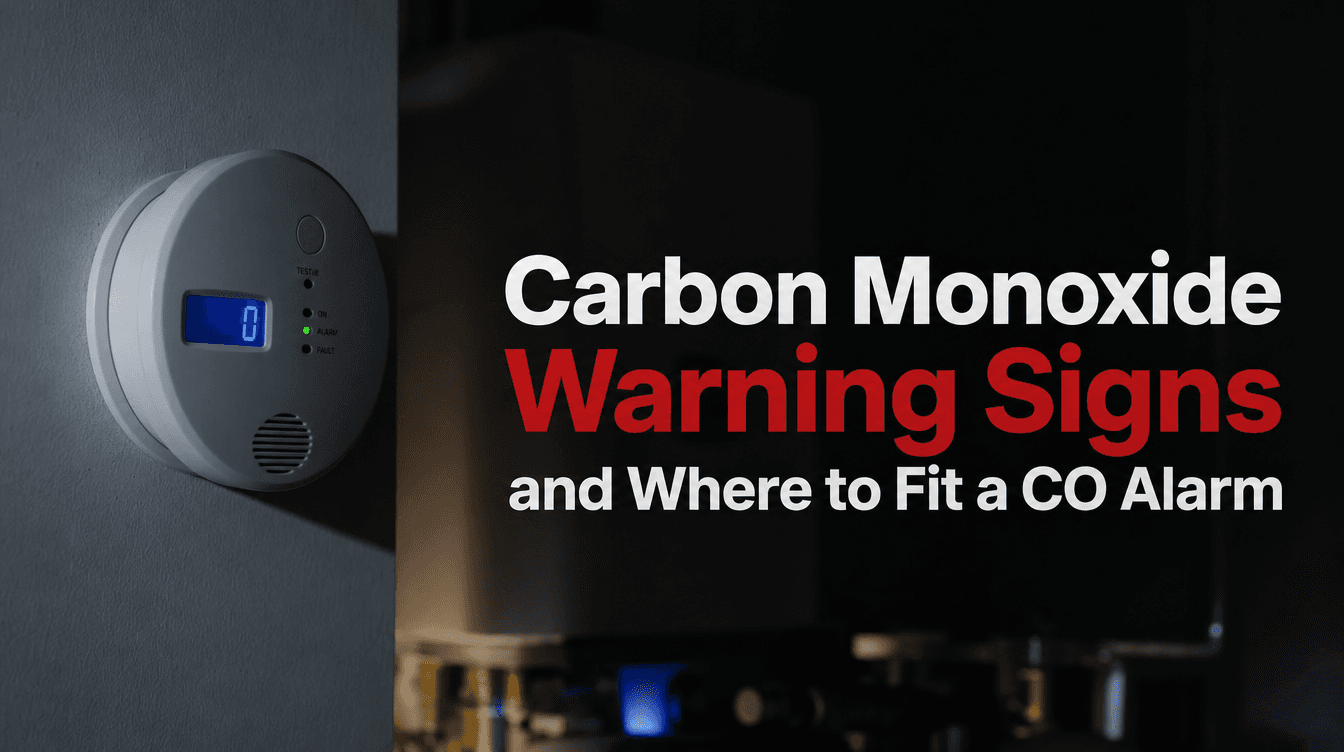
Carbon monoxide doesn't announce itself. You can't see it, smell it or taste it, and the first signs are easy to put down to a cold, a late night or a stuffy room. That's what makes it so dangerous, and it's why a working carbon monoxide alarm is the one piece of safety kit I'd want in every home with a gas boiler.
Here's the short version. Carbon monoxide (CO) comes from fuel that isn't burning properly, usually because an appliance is faulty, badly fitted or overdue a service. The warning signs are a yellow or orange flame, sooty marks, extra condensation and a pilot light that keeps going out. The symptoms are headaches, dizziness, nausea and breathlessness that lift once you're out of the house. Fit an audible alarm marked to BS EN 50291 in the room with your boiler, keep it between 1 and 3 metres from the appliance, and have the boiler serviced every year.
Danny here. Adam and I own and run Eco Heat Surge together. We test for carbon monoxide on each boiler service and gas safety check we carry out, so this is the guidance I give customers across South Yorkshire when they ask what they should have in place.
If you think there's carbon monoxide in your home right now, stop reading. Get outside into fresh air and phone 0800 111 999, the free national gas emergency line. If anyone is struggling to breathe, confused or has collapsed, ring 999.
What is carbon monoxide and where does it come from?
Carbon monoxide is a poisonous gas that forms when fuel burns without enough oxygen. A healthy gas boiler burns cleanly and sends its waste gases out through the flue. When something goes wrong, such as a blocked flue, a damaged seal, a burner that needs cleaning or ventilation that's been covered over, the fuel stops burning cleanly and CO can build up indoors.
The Gas Safe Register's carbon monoxide factsheet puts it plainly: it can make you seriously ill and can kill quickly without warning. The NHS lists the usual sources as gas boilers, cookers, heaters and fireplaces, along with portable generators and vehicle engines left running in enclosed spaces.
For a gas boiler, the protection is a combination of the flue doing its job and the burner being set up correctly. That's why a flue gas reading and a CO check are part of every service we carry out.
Warning signs on your gas appliances
Before anyone feels unwell, the appliance itself often gives the game away. Watch for:
- A floppy yellow or orange flame on a gas hob or fire, instead of a clean blue one
- Dark, sooty staining on or around a boiler, fire or cooker
- More condensation than usual on the inside of your windows
- A pilot light that keeps blowing out on an older boiler or fire
None of these proves there's carbon monoxide in the air, but each one means an appliance isn't burning as it should. Stop using it until a Gas Safe engineer has inspected it. Our guide to the signs an ageing boiler is due for replacement covers some of the other clues an ageing boiler gives.
Symptoms of carbon monoxide poisoning
The NHS guidance on carbon monoxide poisoning lists these symptoms:
- Headache
- Dizziness
- Feeling or being sick
- Feeling weak, tired or confused
- Chest and muscle pain
- Shortness of breath
They look a lot like flu or a hangover, which is exactly why people miss them. The pattern is the giveaway. The NHS notes that symptoms can get worse the longer you spend in an affected room and ease off once you leave or go outside. London Fire Brigade adds that pets can be affected too. If that rings true in your home, carbon monoxide needs ruling out.
| What you notice | Could it be CO? | What to do |
|---|---|---|
| Headaches that clear up when you go out | Possibly | Get fresh air, stop using gas appliances, speak to your GP or NHS 111 |
| Symptoms that are worse in one particular room | Possibly | Stop using gas appliances, get fresh air, call 0800 111 999 |
| Yellow flame or soot on an appliance, no symptoms | A warning sign | Stop using the appliance and book a Gas Safe engineer |
| Your CO alarm is sounding | Treat it as real | Follow the steps below straight away |
| Difficulty breathing, confusion or collapse | Emergency | Call 999 |
What to do if your carbon monoxide alarm goes off
Never assume it's a false alarm. The Gas Safe Register and the NHS both set out the same basic steps:
- Get fresh air straight away. Open doors and windows as you go.
- Turn off your gas appliances if you can do so quickly, and stop using anything you think could be the source.
- Get everyone out of the house, including pets, and don't go back in until you've been given advice.
- Ring 0800 111 999. It's the free gas emergency number and it's staffed 24 hours a day.
- Get medical advice. Call 999 if anyone has difficulty breathing, sudden confusion or has lost consciousness. For milder symptoms, speak to your GP or call NHS 111.
Northern Gas Networks explains that an emergency engineer is sent straight out to carry out a safety check, make the situation safe and give you advice. Once that's done, the appliance shouldn't be used again until a Gas Safe engineer has found and fixed the cause. That's the point where you'd call a firm like ours to trace the fault and put it right.
Choosing the right carbon monoxide alarm
Not every alarm on the shelf is worth having. The Gas Safe Register says to look for one marked to BS EN 50291. The Building Regulations guidance in Approved Document J goes further for alarms fitted alongside a new boiler: BS EN 50291-1:2018, powered by a battery built to last the alarm's whole working life, with a warning that tells you when that life is running out.
| Type of alarm | Good for | Worth knowing |
|---|---|---|
| Sealed-battery alarm (working-life battery) | Most homes | No mains wiring needed, and it warns you when it's time for a replacement |
| Hard-wired mains alarm (Type A) | Homes that want alarms linked to other devices | Accepted under the Building Regulations guidance if it has a sensor failure warning |
| Plug-in mains alarm | A stopgap at best | Not an accepted option under the Building Regulations guidance for new installs |
| Colour-change "spot" detector | Nothing on its own | Makes no noise, so it won't wake you or warn you from another room |
The NHS is clear that you want an alarm that makes a loud sound, and London Fire Brigade specifically warns against colour-change or "black spot" indicators. A card that changes colour only helps if you happen to be looking at it.
Where to put a carbon monoxide alarm
Always follow the instructions that come with your alarm first. Beyond that, the Building Regulations guidance for alarms fitted alongside a new or replacement boiler says:
- Put it in the same room as the appliance.
- Keep it between 1 and 3 metres horizontally from the appliance.
- On a ceiling, keep it at least 300mm away from any wall.
- On a wall, fit it as high as you can, above any doors and windows, but not within 150mm of the ceiling.
The government's guidance for landlords describes a slightly different rule of thumb: roughly head height on a wall or shelf, again 1 to 3 metres from the appliance. Both agree on the important parts. The alarm belongs in the room with the appliance, within that 1 to 3 metre band.
If your boiler is in a cupboard, a loft or another awkward spot, ask your engineer at the next service and they'll show you where the alarm should go.
Do you have to have a carbon monoxide alarm?
It depends on who you are and what work is being done.
If you're a landlord in England, the Smoke and Carbon Monoxide Alarm (Amendment) Regulations 2022 have applied since 1 October 2022. You must have a CO alarm in every room used as living accommodation that contains a fixed combustion appliance, which includes a gas boiler. Gas cookers are excluded. Bathrooms count as living accommodation, and so do halls and landings. You also have to check the alarms work on the first day of each new tenancy, and repair or replace one when a tenant reports it faulty. The rules cover private landlords and social housing providers, and councils can fine up to £5,000 where a landlord ignores a remedial notice.
Our guide to landlord gas safety certificates explains how the yearly CP12 check fits in alongside this.
If you're having a new boiler fitted, Approved Document J has said since October 2022 that when a new or replacement fixed gas appliance goes into a home (anything other than cooking appliances), a CO alarm should be provided in the room where it's located. That applies to owner-occupiers too, so it's worth checking it's included when you get quotes for a new boiler installation.
If you own your home and aren't changing anything, there's no law forcing you to fit one. The NHS still recommends an alarm in each room that has a fuel-burning appliance, and I'd say the same. It's a small, cheap thing that covers the one risk you can't sense for yourself.
Looking after your alarm
An alarm only helps if it's working. A few habits make sure it is:
- Press the test button as often as the manufacturer recommends, and after you've been away.
- Don't paint over it, cover it or tuck it behind curtains.
- Replace it when it tells you to. Sealed-battery alarms give an end-of-life warning, and when yours does, swap the whole unit.
- Never take the battery out of a replaceable-battery alarm to use elsewhere, even for a day.
An alarm is a backstop, not a substitute for servicing
A CO alarm tells you something has gone wrong. A service stops it going wrong in the first place. The Gas Safe Register's advice is to get gas appliances looked at once a year by a registered engineer, and to keep air vents clear so appliances can breathe.
Our annual boiler service includes flue gas analysis and a carbon monoxide check around the boiler, and it costs £80. For landlords, our gas safety check includes checking that a CO alarm is fitted and working, with the CP12 certificate at £70 for a single property.
If you've spotted any of the warning signs above, you're not sure your alarm is in the right place, or your boiler is overdue a service, call us on 01226 885022 or get in touch online. The phone comes straight through to Adam or me, and we'll get it looked at properly.
Frequently asked questions
Where should I put a carbon monoxide alarm?
In the same room as your boiler or other fuel-burning appliance, between 1 and 3 metres from it. Building Regulations guidance says ceiling alarms should sit at least 300mm from any wall, and wall alarms as high as possible above doors and windows but not within 150mm of the ceiling. Always follow the alarm's own instructions too.
Do landlords have to fit carbon monoxide alarms?
Yes, in England. Since 1 October 2022, landlords must fit a CO alarm in any room used as living accommodation that has a fixed combustion appliance, such as a gas boiler. Gas cookers are excluded. Alarms must be checked on the first day of a new tenancy and fixed or replaced when reported faulty.
Does a new boiler need a carbon monoxide alarm?
Yes. Since October 2022, Approved Document J says that when a new or replacement fixed gas appliance (other than a cooking appliance) is installed in a home, a CO alarm should be provided in the same room. That applies to owner-occupied homes as well as rented ones, so check it's included in your installation.
What are the first signs of carbon monoxide poisoning?
Headaches, dizziness, feeling sick, tiredness, confusion and shortness of breath are the common early symptoms. They're easy to mistake for flu. The biggest clue is that you feel better when you leave the house, or several people at home feel unwell together. If you suspect CO, get into fresh air and phone 0800 111 999 for help.
Do I need a carbon monoxide alarm in a kitchen with a gas hob?
Not by law. The landlord rules and the Building Regulations guidance both leave out gas cookers. The NHS still recommends an alarm in every room with a fuel-burning appliance, and a gas hob counts, so fitting one is sensible. Follow the alarm's own instructions on where to position it in a kitchen.
Is a carbon monoxide alarm enough without a boiler service?
No. An alarm only warns you once carbon monoxide is already in the room. A yearly service by a registered Gas Safe engineer checks the flue, the burner and the combustion readings so the fault is caught before it produces CO. The Gas Safe Register recommends both: a yearly check and an alarm marked to BS EN 50291.
Get more like this
One honest email a month.
Boiler tips, heat pump advice, and answers to the questions our customers actually ask.