There is a particular sinking feeling that comes with glancing at your boiler and seeing the pressure needle sitting well below where it should be.
Maybe the heating has gone cold, or the boiler has thrown up a low-pressure fault code and refused to fire. Either way the house is cooling down, and you want to know whether this is a two-minute fix or the start of something expensive.
Here is the short version. A sealed heating system is built to hold its pressure for months on end, so when it keeps falling, water is getting out somewhere it should not. Topping the system back up will usually get your heat going again, but that only treats the symptom.
The cause is almost always one of four things: a leak in the system, a pressure relief valve letting water out, a tired expansion vessel, or simply that you have recently bled the radiators.
This guide walks through each one, the safe checks you can do yourself, and the point at which it stops being a top-up job and becomes one for an engineer.
Before anything else, a safety point. If you ever catch the smell of gas, leave the switches alone, open the house up, get everyone outside, and call the gas emergency line on 0800 111 999.
National Gas sets out exactly what to do in their safety guidance. A loss of pressure by itself is not a gas emergency, but that warning always has to come first.
My name is Danny. Two of us run Eco Heat Surge, both working engineers, and chasing down leaks and pressure faults fills a good part of my week. This is how I would talk it through with you on the doorstep.
What boiler pressure is, and the number you are looking for
Your central heating is a closed loop of water running from the boiler out to the radiators and back. For it to push hot water around the house properly, that loop has to sit under a gentle, steady pressure.
On almost every boiler you will find a gauge on the front, and when the system is cold the needle should rest somewhere between 1 and 1.5 bar. As the water heats up and expands it is normal to see it climb a little, often towards 2 bar, then settle back as everything cools.
Trouble starts when the cold reading drifts below about 1 bar. Most modern boilers treat low pressure as a fault and shut themselves down rather than run short of water, which is why a slow loss so often ends with a boiler that simply will not light.
A one-off top-up back into the normal band is perfectly reasonable. Having to do it again and again is the system telling you something is wrong.
Why your boiler keeps losing pressure
Four causes account for nearly every dropping-pressure call I go out to. Often the symptoms point you towards which one you are dealing with.
A leak somewhere in the system
This is the most common reason by a distance. Because the system is sealed, even a slow weep from a radiator valve, a pipe joint, a towel rail or the boiler itself will, over a few weeks, pull the pressure down.
The leaks that are easy to spot are the ones under radiators and around valves. The awkward ones hide beneath floorboards, inside walls or under the boiler casing, where you may never see a drop of water even though litres are escaping over time.
The pressure relief valve is passing
Every sealed boiler has a pressure relief valve, a safety device that opens to release water if the pressure ever climbs too high. What it lets out runs away through a small pipe that ends on an outside wall.
When that valve wears, or a fleck of grit lodges in it, it can start passing water even at normal pressure, quietly draining your system to the outdoors. The giveaway is dripping or staining from that little pipe outside, often after the heating has been running.
A failed expansion vessel
Inside or close to the boiler sits an expansion vessel, a sealed tank with a rubber diaphragm and a cushion of air that absorbs the extra volume as the water heats and expands. After several years, commonly somewhere around the six to eight year mark, that diaphragm tires and the air cushion is lost.
The pressure then swings up sharply when the heating is on and falls back as it cools, and over time it can drop away altogether. This one is hard to judge by eye and usually needs an engineer to test and recharge or replace the vessel.
You have just bled the radiators
A more cheerful one. If you have recently let air out of your radiators, you have also let a little water and pressure out with it, so a low reading straight afterwards is entirely normal.
Top it back up to the correct band, and as long as it then holds steady there is nothing else to worry about. If it carries on falling after that, you are back to one of the three causes above.
What you can safely check yourself
None of the checks below need tools, and none of them involve opening the boiler or going anywhere near the gas. Anything inside the casing belongs to a Gas Safe registered engineer, every time.
- Look for damp patches and stains. Walk the house and check under and behind every radiator, around the valves, and along the visible pipe runs, including the airing cupboard and under the boiler.
You are hunting for damp carpet, tide marks, rusty streaks or a green crust on brass fittings that gives a slow leak away.
-
Check the discharge pipe outside. Find the small pipe that leaves the wall near the boiler, the one the pressure relief valve drains through. If it is dripping, wet or stained, that valve is very likely passing and letting your pressure escape into the garden.
-
Check the radiators and their valves. Run a hand around each valve, the nut where the pipe meets the radiator, and the bleed point. A weep here is slow but steady, and it is a frequent quiet culprit.
-
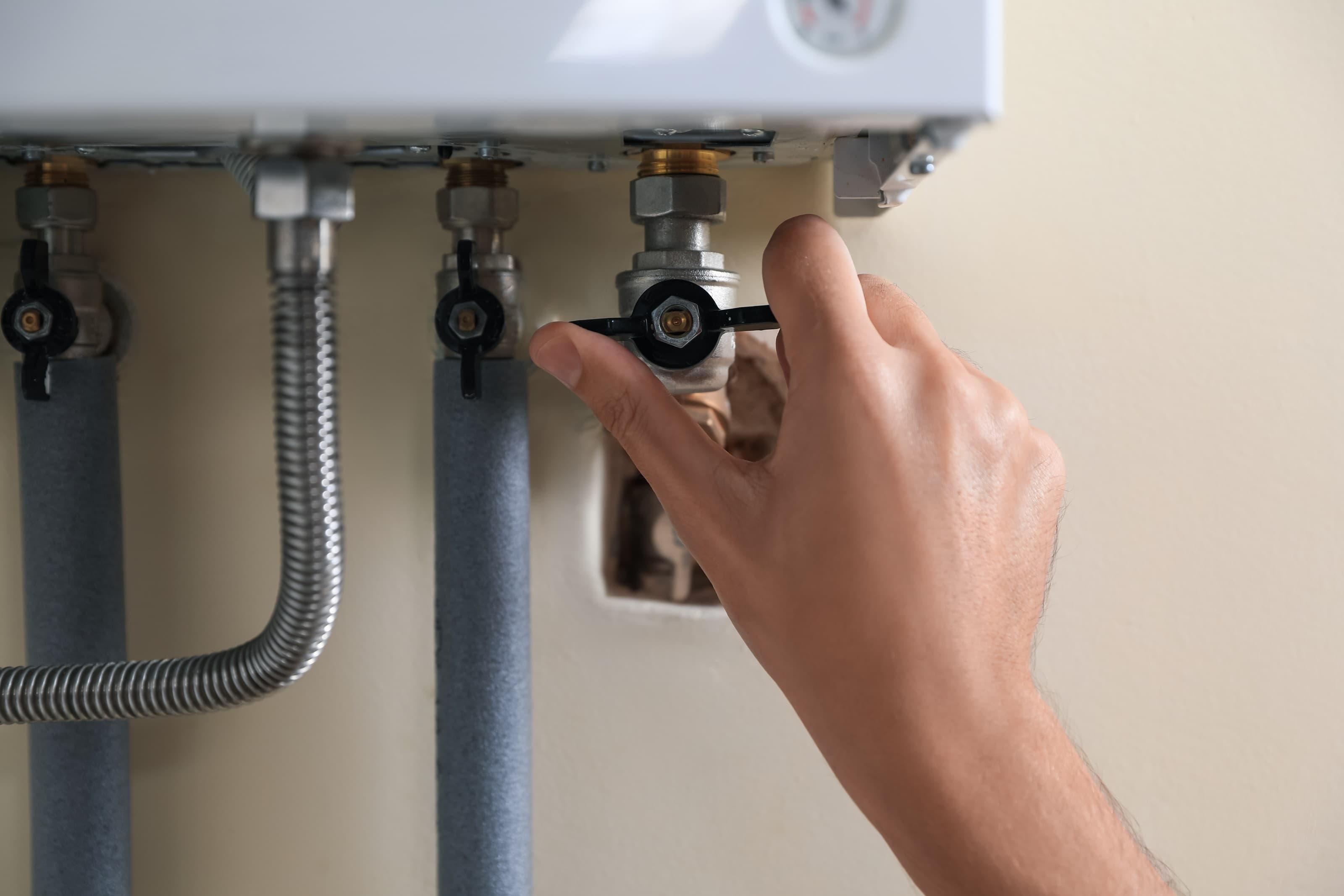
Top up through the filling loop. If the manual for your boiler explains the steps, you can use the filling loop, the small braided hose with a valve or two beneath the boiler, to bring the cold pressure back to between 1 and 1.5 bar.
Open it gently, watch the gauge, and close it the moment you reach the right band. Where there is no clear guidance for your model, hand this one to an engineer rather than guess. Makers such as Ideal walk through it with photos in their homeowner guides.
-
Watch whether it holds. Once you are back in the normal band, keep an eye on the gauge over the next few hours and days. Whether the pressure stays put or starts sliding again is the single most useful thing you can tell an engineer.
-
Note the pattern before you call. Write down how often you are topping up, and whether the drop happens while the heating is running or while it sits idle. That pattern tells an engineer a great deal before they even arrive.
When a top-up is not enough
Topping up is fine as a short-term fix, but some signs mean the fault underneath needs sorting properly rather than papering over.
Call a Gas Safe engineer if the pressure falls again within hours or a day of topping it up, if you find yourself doing it every week, if the outside discharge pipe is dripping, or if the gauge keeps dropping with no leak you can find anywhere.
That last one matters: a hidden leak or a failing expansion vessel can drain a system steadily while leaving nothing for you to point at. Repeated low-pressure lockouts are the same message in a different form.
This is the part of the job I genuinely enjoy. We pressure-test the system, trace the loss back to its real source rather than guess at it, and put it right, whether that turns out to be a leaking joint, a passing relief valve or a spent expansion vessel.
We cover same-day emergency boiler repair across Barnsley and the wider South Yorkshire area, from the S70 to S75 postcodes out to Sheffield, Rotherham and Doncaster, with a straight diagnosis and a price fixed in writing before any work starts. If you are not sure you are in range, you can check the areas we cover.
How to stop it happening again
Most pressure problems give plenty of warning if you are looking for it. An annual boiler service is the simplest safeguard, because a passing relief valve, a weakening expansion vessel and an overnight pressure drop all show up on a proper service long before they leave you cold.
Booking it for late summer, ahead of the autumn rush, means small faults get caught while engineers still have room in the diary.
Beyond that, try not to over-bleed your radiators, since every bleed costs you a little pressure. Glance at the gauge now and then through the heating season, so a slow loss does not catch you out on a frosty morning.
And if your boiler is past about eight years old and the pressure has started behaving oddly, bear in mind that the expansion vessel may simply be reaching the end of its life.
If your boiler keeps losing pressure
If you have looked for leaks, topped the system up and it still will not hold, it needs an engineer to find the source properly, not another top-up. The reassuring part is that the usual culprits, a leaking joint, a tired relief valve or a failed expansion vessel, are all repairable parts and rarely a reason to replace the whole boiler.
If your heating has been the kind that needs constant attention, it is also worth a read of our guide on what to check when your boiler will not turn on, since low pressure is one of the things that stops a boiler firing in the first place.
And if you would rather just have it sorted, get in touch or call us on 01226 885022 and we will get you warm again. If you want to confirm we are listed before we visit, our details are on the Gas Safe Register.
Frequently asked questions
Why does my boiler keep losing pressure?
A sealed heating system should hold its pressure, so a steady drop means water is escaping somewhere. The usual causes are a leak from a radiator valve, a pipe joint or the boiler, a pressure relief valve passing water outside, or a failed expansion vessel. Bleeding radiators also lowers it temporarily.
Is it safe to use a boiler with low pressure?
Most boilers simply lock out at low pressure as a built-in safety measure, so they will not run in a way that damages them. Topping up once is fine, but if it keeps dropping, have it checked. If you can see a leak or smell gas, stop and call an engineer rather than carry on.
How do I repressurise my boiler?
Use the filling loop, the small braided hose beneath the boiler, following your manual. With the system cold, open it gently, watch the gauge, and close it once you reach 1 to 1.5 bar. If you cannot find clear instructions for your model, leave it to a Gas Safe engineer rather than guess.
How often should I need to top up my boiler?
Rarely. A healthy system might need a small top-up once a year, or just after you have bled the radiators. If you are topping up every week or month, that is not normal and points to a leak or a faulty part that an engineer should trace and put right.
Why is my boiler losing pressure with no visible leak?
The leak may be hidden under floors, inside a wall or beneath the boiler casing, where you never see the water. It can also be a pressure relief valve venting outside or a failed expansion vessel. An engineer can pressure-test the system to find the real source.
Does losing pressure mean I need a new boiler?
Usually not. The common causes, a leaking joint, a passing relief valve or a spent expansion vessel, are all repairable parts. A new boiler is only worth considering if yours is very old and these faults are stacking up alongside other problems.
Get more like this
One honest email a month.
Boiler tips, heat pump advice, and answers to the questions our customers actually ask.