Finding water under your boiler is a horrible moment, especially when it's cold out and the heating is the one thing you can't do without. Take a breath, though, because a boiler leaking water is nearly always down to one of three things: the pressure relief valve letting water out, an expansion vessel that's stopped doing its job, or a pipe joint that's worn, and every one of those can be repaired.
What you do in the next ten minutes matters most. Find where it's wet, have a look at the pressure gauge, and leave the front casing on. Once you've written down the reading, switch the boiler off and close the cold water valve underneath it while you sort out help. If the gauge says the pressure is too high, there's a safe way to bring it down yourself, and I'll walk you through it further down.
I'm Danny, and I share the engineering at Eco Heat Surge with Adam from our base in Manvers. If you'd rather not touch a thing, that's completely fair: ring 01226 885022 and our boiler repair service, which covers South Yorkshire with Barnsley included, can take it from there.
When does a leaking boiler become unsafe?
A bit of water on the floor rarely hurts anyone by itself, but it can end up somewhere it shouldn't, and people do odd things in a panic, so run through these before anything else.
- If you can smell gas, forget the leak for now. Don't touch any light switches, open the windows, turn the gas off at the meter lever if you can get to it safely, get everyone out of the house and ring 0800 111 999.
- If water is running onto wiring, a plug or a socket, keep your hands off it, especially if they're wet or you're standing in the puddle. Keep everyone away from that corner and call an engineer.
- Please don't take the front cover off. Ideal's own advice on what to do when your boiler is leaking is not to try fixing anything yourself, because gas, water and electricity all sit side by side in there. I'd tell you the same, and anything behind the casing is a job for an engineer on the Gas Safe Register.
Once you've ruled those out, you can safely do a bit of detective work.
Is it actually the boiler that's leaking?
Before you assume the worst, check it really is the boiler. Plenty of boilers sit in a kitchen or utility room right next to a washing machine, a dishwasher or a sink, and water has a habit of travelling. A slow drip from a waste pipe can run along the bottom of a cupboard and end up pooling under the boiler, which then gets all the blame.
Ideal suggests running a dry cloth or your fingers along the pipes around the puddle to find where it's actually wet. Start at the bottom and work your way up. Water runs downhill, so the highest wet spot you can find is usually the one closest to the source.
If the trail ends at the washing machine hose or the sink trap, you can relax a little, because that's a plumbing fix and the boiler itself is fine. If it leads back up to the boiler or the pipes directly under it, keep reading.
Where exactly is the water coming from?
Where the water turns up tells you a lot about what's behind it. This table won't diagnose the fault for you, but it'll help you make sense of what you're looking at and describe it clearly when you ring.
| Where you see water | What it usually points to | What you can do |
|---|---|---|
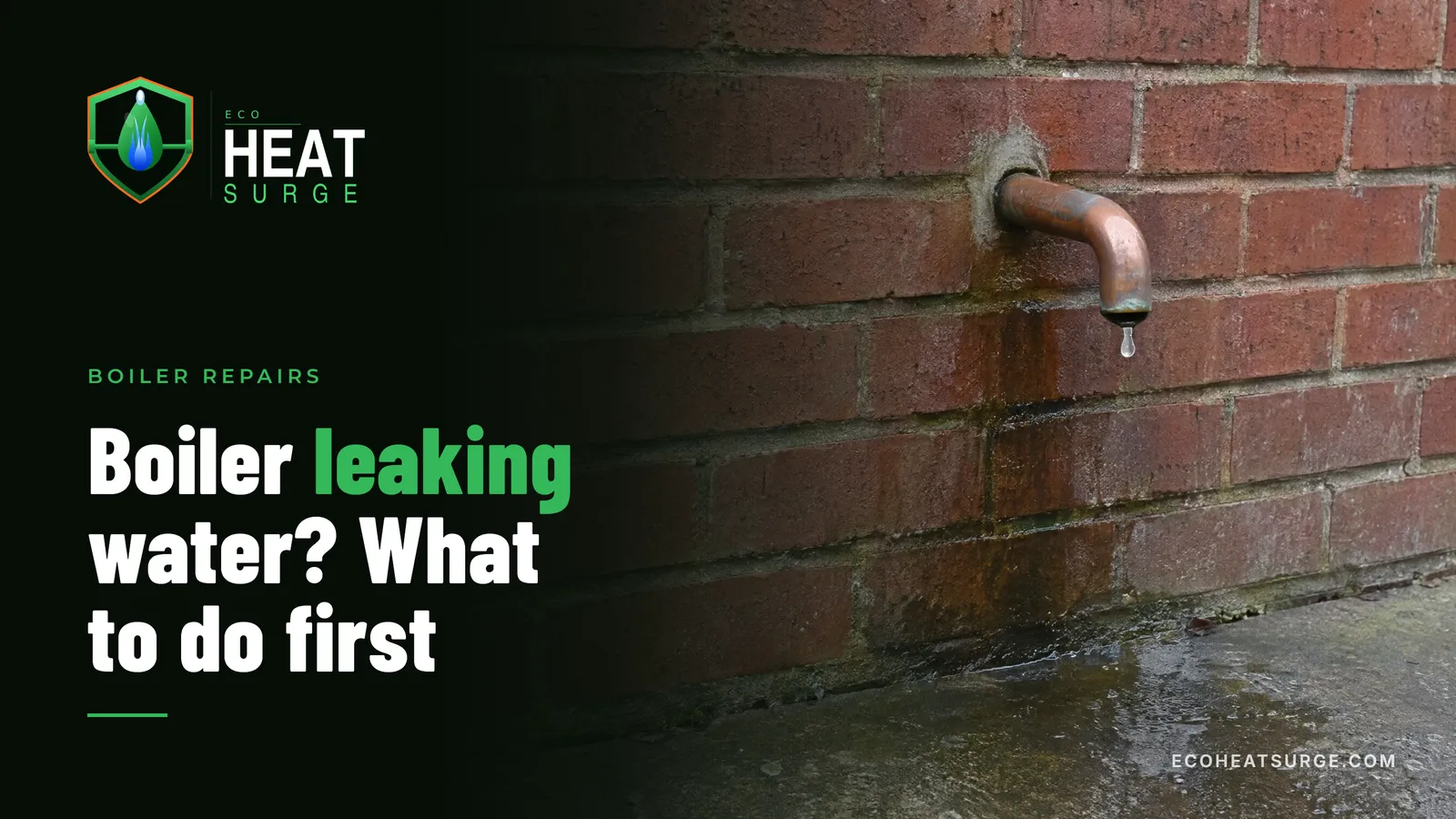
| Dripping from a small copper pipe on the outside wall | The relief valve letting water out, either because the pressure is too high or the valve is worn | Check the pressure gauge (see the next section) |
| Pipes or joints underneath the boiler | A joint or valve that's worked loose or worn its seal | Catch the drips and book an engineer |
| From inside the casing, dripping off the bottom | An internal seal, the pump or the heat exchanger | Leave the casing shut and book an engineer |
| A joint on the plastic condensate pipe | A fitting that's come apart or cracked | Book an engineer, especially if it's inside the house |
| Only when the heating is running | Pressure rising as the water warms, often linked to the expansion vessel | Check the gauge with the heating on and again with it off |
That little pipe on the outside wall is easy to miss, so go and have a proper look at it. Worcester Bosch's guidance on pressure loss in a heating system asks homeowners to check whether it's wet or dripping, because that can mean the valve is faulty.
Why is my boiler leaking water when the heating is on?
If the drip only shows up once the heating has been on for a while, I'd look at the pressure first.
Water expands as it warms, so it's normal for the needle on your pressure gauge to creep up a bit with the heating on. Ideal says somewhere between 1 and 1.5 bar with the heating off is about right, and that it should stay close to that once the heating is running.
If it's well above that (Ideal treats 2 bar or more as the warning sign), high pressure may well be what's causing the leak. The pressure relief valve is there to let water out when the pressure gets too high, so in that situation it's actually doing its job and protecting the boiler. Ideal gives two common reasons the pressure climbs that far.
The first is a filling loop that's been left open. If someone topped the system up and didn't fully close both valves on the filling loop afterwards, mains water can keep seeping in and pushing the pressure up. It's an easy mistake to make, and closing those valves is the first step in the fix below.
The second is an expansion vessel that's stopped working properly. That's a tank inside or near the boiler that gives the heated water somewhere to expand into, and when it fails, the pressure spikes every time the heating warms up. You'll need an engineer to check whether it's gone.
If the pressure looks normal and it's still leaking, wear is the more likely culprit, whether that's a tired joint, a seal, the pump or the heat exchanger. Ideal notes that the fix can be anything from a bit of soldering to a whole new boiler, which is exactly why somebody needs to look at it properly before anyone gives you a price.
How do I bring high boiler pressure down safely?
If the gauge reads well over 1.5 bar with the heating off, and the water is coming from that outside pipe or the relief valve, you can often sort it yourself. Go through it in this order:
- Close the filling loop. Look for the braided hose or key under the boiler and check both valves on it are fully shut.
- Turn the heating off and wait for the radiators to cool. A hot radiator can spit scalding water when you bleed it, so don't rush this bit.
- Bleed a radiator. Hold a cloth under the bleed valve, open it a little with a radiator key and let the water out slowly. It can take a while for the pressure to drop, so be patient with it.
- Keep an eye on the gauge. Close the bleed valve once the needle is back between 1 and 1.5 bar, then watch whether the leak stops.
If the pressure won't come down, creeps back up after you've sorted it, or the leak carries on at normal pressure, that's where I'd stop and let an engineer take over. Topping up and draining the system again and again won't cure anything, and it tends to hide whatever is really wrong. And if you've got the opposite problem, with the needle dropping and you topping it up every week, have a read of why boiler pressure drops and how to fix it instead.
What should you do before the engineer arrives?
A few minutes of preparation now saves a lot of time once someone is at your door.
Before you switch anything off, jot down the pressure reading with the heating on and again with it off, and notice whether the drip starts and stops with the heating. Then turn the boiler off and close the cold water valve underneath it.
Put a bowl or a baking tray under the drip with a towel round it, which protects your floor and any ceiling below. If the boiler is upstairs, it's sensible to check the ceiling underneath for a damp patch while you're at it. Then move whatever is stored under or around the boiler, so there's room to work when we arrive.
It really helps to have the make, model and any fault code on the display to hand, and if you can, take a clear photo of the data label. Snap the wet patch too, before you mop it up, because a slow leak can dry out by the time anyone gets there and you'll want to show us where it was.
If you can give us the fault code and model when you ring, we can often order the part before we set off, so you're not left waiting for a second visit after we've diagnosed it.
What happens when you call us out?
Before anyone drives out to you, we tell you the exact callout fee. It's based on where you live and what time you ring, and if you go ahead with the repair, it comes off the final bill. Once we've found the cause, we put the cost of parts and labour in writing so you can decide before any repair work starts, and there's no separate diagnostic fee added on top.
How quickly we can get to you depends on where you are:
| Area | How soon we aim to be there |
|---|---|
| Barnsley town and S70 to S75 | Same day where possible |
| Penistone, Cudworth and Hoyland | Same or next day |
| Sheffield and Rotherham | Next day priority |
| Doncaster and Wakefield | Within 48 hours |
The office is open from 8am to 5pm on weekdays. We do try to help at weekends too, but that depends on how busy we are, and on winter weekends those response times can stretch.
We won't talk you into a new boiler when a cheaper part will sort it, and nothing goes ahead until you're happy with the written quote. If you live close to our base, our Barnsley heating engineers page lists the villages and postcodes we can reach quickest.
Still dripping? Let us have a look
If you've worked through all of this and you're still looking at a boiler leaking water, or you just can't work out where it's coming from, don't sit there worrying about it. Get in touch with us or call 01226 885022, tell me what you're seeing, and we'll talk you through it.
Frequently asked questions
Is it normal for water to come out of the condensate pipe?
Yes, up to a point. A condensing boiler makes water while it's running and sends it down the plastic condensate pipe to a drain, so a trickle at the drain end while the boiler is firing is perfectly normal. Water escaping from a joint partway along that pipe, or a puddle indoors, isn't, and that needs looking at.
Who should I call for a leak, a plumber or a gas engineer?
That depends on where the water is coming from. Ideal points out that a leaking water pipe is normally a straightforward plumbing repair, so if you've traced it to a sink, an appliance hose or ordinary pipework, you don't need a gas engineer. If it's coming from the boiler itself, the relief valve or the pipes going into it, call someone Gas Safe registered.
How quickly can a leaking boiler be fixed?
It depends on what's caused it. As a rough guide, once we've diagnosed the problem, re-pressurising an expansion vessel usually takes us 30 to 45 minutes, a pump an hour and a half to two hours, and a plate heat exchanger two to three hours.
Does a leaking boiler mean I need a new one?
Often it doesn't. The usual suspects are the pressure relief valve, the expansion vessel or a pipe joint, and each of those can be fixed on its own. If a repair honestly isn't worth paying for on an older boiler, we'll tell you straight instead of patching it up, and either way you get a written price.
Will my boiler warranty cover a leak?
Possibly. Ideal says repairs should be free while a boiler is within its warranty period, but it also makes a yearly service a condition of that warranty, so if yours hasn't been serviced in the last 12 months you may be asked to pay. Dig out your warranty paperwork before you ring anyone.
Get more like this
One honest email a month.
Boiler tips, heat pump advice, and answers to the questions our customers actually ask.