The heating was fine when you went to bed. Now there's frost on the car, the radiators are cold, and the boiler is showing a fault code or gurgling to itself. When that happens on a freezing morning, the first thing I'd look at isn't inside the boiler at all. It's the thin plastic pipe that runs from the bottom of it to a drain outside.
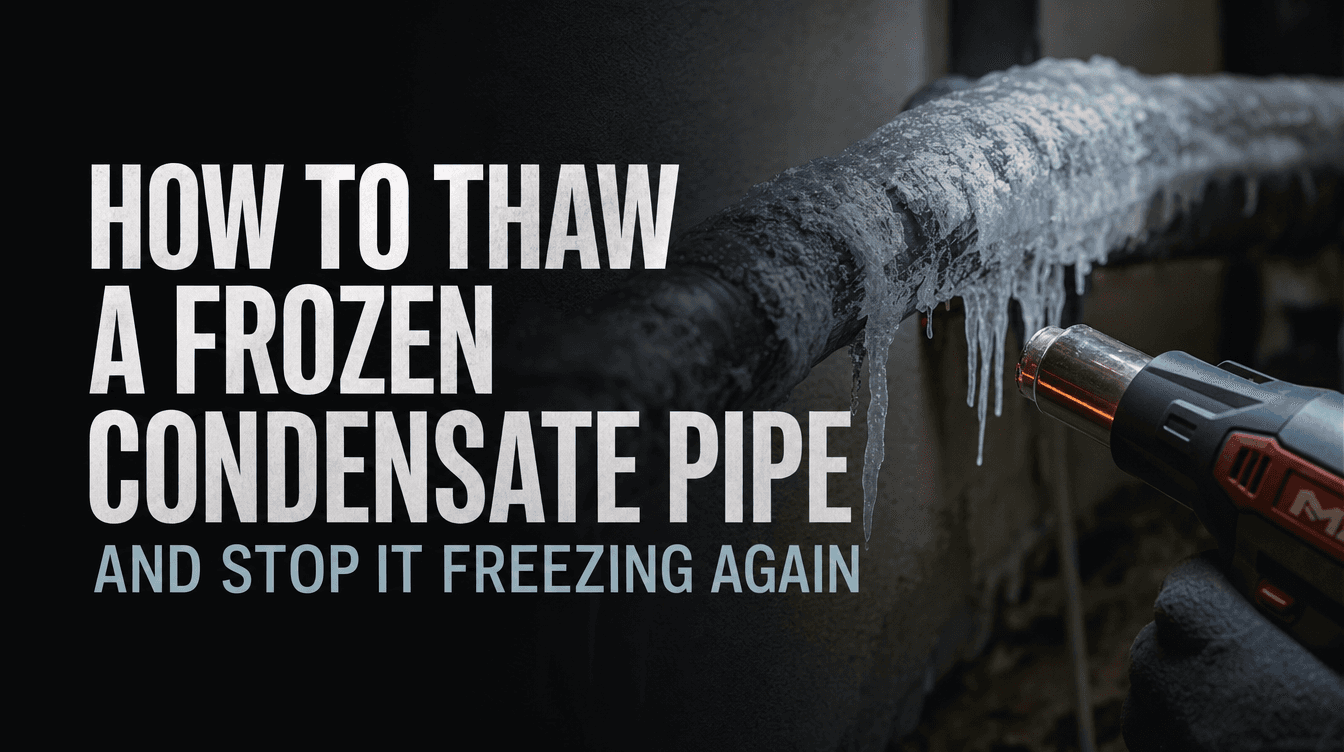
A frozen condensate pipe is one of the few boiler faults you can usually put right yourself. Find where the pipe runs outside, work out which section has iced up, warm it gently with a hot water bottle or warm tap water, then reset the boiler. Never use boiling water, because it can crack the pipe. Worcester Bosch backs this up in its advice on frozen condensate pipes, where it says most people can sort it without calling anyone out.
This one's from me, Danny. I run Eco Heat Surge with Adam, and between us we answer the phone and do the repairs. Below is what I'd tell you if you rang us on a cold morning with a boiler that had just given up.
One safety note before we start. A frozen pipe has nothing to do with gas, but a whiff of gas is a different matter entirely. Leave light switches and plugs alone, throw the windows open, take everyone outdoors and ring the gas emergency number, 0800 111 999, straight away.
What is a condensate pipe, and why does it freeze?
Modern gas boilers are condensing boilers. They squeeze extra heat out of the hot flue gases, and as those gases cool, they turn back into water. That water is mildly acidic, so it can't just drip out of the flue. It drains through a small plastic pipe, usually white or grey, into a soil stack, a waste pipe or an outside drain.
The trouble is how slowly it moves. Condensate trickles out a little at a time, and on an outside wall in a hard frost that trickle can freeze before it reaches the drain. Ice builds up layer by layer until the pipe is blocked. The water then has nowhere to go, it backs up towards the boiler, and the boiler shuts itself down to protect itself.
The Heating and Hotwater Industry Council (HHIC), the trade body for boiler manufacturers, says in its installer guide to condensate pipework that the vast majority of these freeze-ups happen where the pipe runs outside for some or all of its length and hasn't been insulated and sealed properly. That matches what we find on callouts.
Signs your condensate pipe has frozen
You're probably looking at a frozen condensate pipe if:
- The boiler stopped overnight or first thing, during a cold snap
- It's making a gurgling or bubbling noise while it tries to fire
- The display shows a fault code. On a Worcester Bosch boiler this is usually EA; other makes use their own codes, so check your manual
- It restarts when you press reset, then cuts out again within minutes
- You can see ice or frost on the outside pipe, or a plug of ice at the end where it meets the drain
If only some of that fits, this table helps narrow it down.
| What you're seeing | Frozen condensate pipe? | What else to check |
|---|---|---|
| Boiler cut out in freezing weather, fault code showing | Very likely | Follow the thawing steps below |
| Gurgling from the boiler on a frosty day | Likely | Look along the outside pipe for ice |
| Pressure gauge reading close to zero | Unlikely | Low system pressure is a separate fault |
| Display completely blank | No | Check the fused spur and your fuse board |
| Gas hob and fire also not working | No | Your gas supply or prepayment meter |
For a no-heat problem that doesn't look like a frozen pipe, our no-heat troubleshooting guide runs through the other common culprits.
How to thaw a frozen condensate pipe
You don't need tools for this, and you don't need to touch the boiler itself. Ideal, whose boilers we're approved installers for, sets out the same method in its advice on defrosting condensate pipes.
- Switch the boiler off. You'll restart it properly once the ice has gone.
- Trace the pipe outside. Follow it from the bottom of the boiler to where it comes out through the wall, then along to the drain.
- Find the frozen section. Vaillant's guide to frozen condensate pipes says the ice usually builds at the most exposed point, typically the end of the pipe just above the drain or a bend where the insulation is thinnest. Viessmann adds flat, level stretches to that list. Frost on the outside of the pipe is a good clue.
- Take off any insulation covering that stretch, so the warmth reaches the pipe.
- Warm the pipe gently. Hold a hot water bottle or a microwaveable heat pad against it, or slowly pour warm water along the frozen part with a jug or watering can. Warm from the tap, or a kettle that's cooled right down, is what you want. It can take a few goes.
- Put the insulation back on once water can run through freely.
- Reset the boiler using the reset or restart button, as your manual describes, and give it a few minutes to fire.
A few things not to do:
- Don't use boiling water. The sudden heat can split plastic pipe, and then you've got a leak to deal with as well.
- Don't use a blowtorch, heat gun or any naked flame on the pipe.
- Don't take electrical appliances outside onto wet, icy ground.
- Don't climb a ladder on frozen ground. If the pipe runs down from a first-floor or loft boiler and you can't reach it safely from the ground, leave it. Ideal's own advice is not to put yourself at risk and to ask a Gas Safe engineer instead.
The water you pour will freeze on the path too, so put some salt or grit down afterwards before someone slips.
What if the boiler still won't restart?
If you've thawed the pipe and the boiler still won't run, don't keep resetting it over and over. Two or three tries is plenty. Ring an engineer if:
- The boiler lights, runs briefly, then locks out with the same code
- You can't find any ice, or can't tell where the pipe ends up
- Part of the pipe runs inside a wall, boxing or loft space where you can't get at it
- Water is dripping from the boiler or pooling underneath it
- The pipe is too high to reach safely
Sometimes the ice is further along than you can see. Sometimes the frost was a coincidence and the boiler has a different fault altogether. Either way, it now needs a Gas Safe registered engineer to take a look.
When you ring us, you'll get Danny or Adam, and we'll tell you what the callout costs before we leave. Once we've found the fault, we put the repair cost in writing, and if you want us to carry on, the callout charge is knocked off the final bill. Our boiler repair service covers Barnsley and the rest of South Yorkshire, and we put vulnerable households first when the weather turns.
While you wait, shut the internal doors and keep one room warm rather than trying to heat the whole house. If you've got a combi, you'll have no hot water either until it's fixed. If you've got a hot water cylinder with an immersion heater, now's the time to switch it on.
How to stop your condensate pipe freezing again
A pipe that froze once will freeze again next time the temperature drops unless something changes. The HHIC guide sets out what good condensate pipework should look like, and these are the points that make the biggest difference:
- Insulate the outside section. The guide asks for pipe insulation at least 13mm thick, waterproof and UV resistant, with every joint sealed and the lagging carried right to the tip of the pipe.
- Use a wider pipe outside. Any external run should be at least 30mm internal diameter. A wider bore takes a lot longer to block with ice than a narrow one.
- Protect the end. Cutting the end of the pipe at 45 degrees and fitting a leaf guard over the drain both help keep wind chill off the most exposed point.
- Bring it indoors if you can. The preferred option is to connect the condensate to an internal soil stack, or to a kitchen or bathroom waste pipe, so it never meets the cold. Where gravity won't do the job, a small condensate pump can.
Vaillant's advice is to keep the boiler running on its timer through a cold spell, including while you're away, rather than switching it off. Worcester Bosch also suggests turning the heating temperature on the boiler up to maximum during a cold spell. The HHIC guide's reasoning is similar: the faster and warmer the condensate drains away, the less chance it has to freeze. Just remember to turn it back down once the cold weather passes.
Here's who can do what:
| Fix | What it involves | Who should do it |
|---|---|---|
| Insulating an existing outside pipe | Waterproof pipe lagging from a DIY store, joints taped | You, if it's reachable from the ground |
| Fitting a leaf guard over the drain | A simple cover over the gully | You |
| Upsizing the outside pipe | Replacing the external run with a wider pipe | An engineer |
| Rerouting to an internal drain | New pipework to a soil stack or waste pipe | An engineer |
| Fitting a condensate pump | A small pump to lift condensate to a drain | An engineer |
Anything that changes the pipework connected to the boiler should follow the manufacturer's instructions. The HHIC guide points out that if those instructions aren't followed, the boiler's warranty may not be valid.
Where we see it most around South Yorkshire
Some homes are more exposed than others. Round Barnsley, two setups come up again and again: 1930s semis, and houses with the combi tucked up in the loft. In both, the condensate pipe often ends up running down a cold north-facing wall, which is exactly where the first hard frost of the year catches it out.
Altitude matters as well. Up in Penistone, roughly 800ft above sea level, the winters bite harder than in the valley towns. Our heating page for Penistone covers the options for rerouting or properly insulating exposed runs in S36.
The easiest time to deal with this is before the first frost. On every annual boiler service we look at how the condensate is run, whether it has the right fall and whether the lagging is up to the job, and we'll tell you if it's likely to freeze. HHIC's guidance says new boilers should have their condensate going to an internal drain wherever that's possible, so it's worth asking about if you're planning a new boiler installation.
Still no heating after thawing?
A frozen condensate pipe is a nuisance, not a disaster, and most of the time a hot water bottle and a few minutes out in the cold will sort it. If the boiler still won't restart, the pipe is out of reach, or it keeps freezing every cold snap, we're happy to help.
Call us on 01226 885022, Monday to Friday, 8am to 5pm, or send us a message. We'll get your heating back on and make sure the pipe doesn't catch you out again this winter.
Frequently asked questions
What are the signs of a frozen condensate pipe?
The boiler usually stops during a cold snap and gurgles when it tries to fire. Many show a fault code (EA on Worcester Bosch boilers), and some restart briefly then lock out again. Check the external run for frost, or a plug of ice at the open end over the drain.
Can I use my boiler while the condensate pipe is frozen?
No. Once the pipe is blocked, the boiler senses the backed-up condensate and refuses to fire, so you lose the heating and, on a combi, the hot water too. Pressing reset before the ice has cleared won't get it going. Thaw the pipe first, then reset the boiler as the manual describes.
Can I pour boiling water on a frozen condensate pipe?
No. Boiling water can crack the plastic pipe, leaving you with a leak on top of the blockage. Use a hot water bottle, a microwaveable heat pad, or warm tap water poured slowly along the frozen section. It may take a few attempts before the ice clears and the boiler will restart.
Do I need an engineer to thaw a condensate pipe?
Usually not, as long as the pipe is reachable from the ground and you don't need to open the boiler. Get a Gas Safe engineer out if the pipe is out of reach, runs through a wall or loft you can't get at, or the boiler keeps locking out after you've thawed it.
How can I stop my condensate pipe freezing?
Insulate the outside section with waterproof lagging at least 13mm thick, sealed at every joint and carried to the tip. Industry guidance also recommends a wider external pipe of at least 30mm internal diameter, a guard over the drain, or better still, rerouting the condensate to an internal drain.
Is a frozen condensate pipe dangerous?
Not in itself. The boiler shuts down to protect itself when condensate backs up, so it's a nuisance rather than a hazard. The risks come from trying to fix it badly: ladders on icy ground, boiling water or naked flames. If you ever smell gas, that's separate: call 0800 111 999.
Get more like this
One honest email a month.
Boiler tips, heat pump advice, and answers to the questions our customers actually ask.