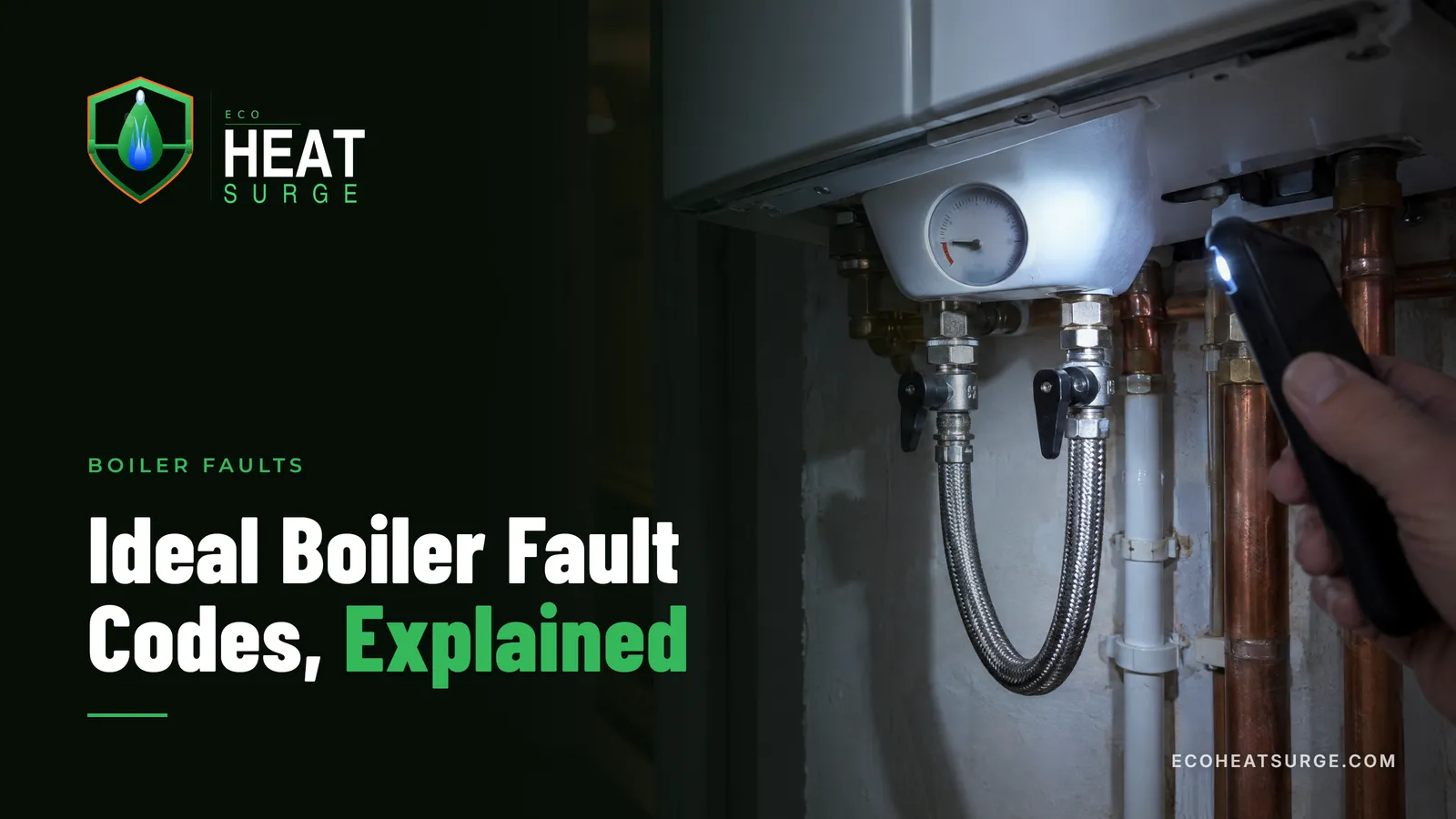
You've typed a letter and a number from your boiler's screen into your phone, hoping it's nothing serious. Here's the reassuring part: Ideal boiler fault codes are there to point at the cause, and a fair few of them clear with a simple check you can make yourself.
The quick version: F1 is low water pressure, F2 means the flame has gone out, L2 is a failed ignition, F3 is the fan and L5 points at the return side of the system. Pressure and gas supply checks are safe for you to do. Anything inside the casing is work for a registered gas engineer.
I'm Danny, co-founder of Eco Heat Surge, and we're Ideal approved installers based in Manvers, Rotherham. Below is what each common code means, according to Ideal's own guidance, what you can safely try, and the point where you should stop and ring someone. If you'd rather skip straight to that, our boiler repair service covers all of South Yorkshire and the number is 01226 885022.
What do Ideal boiler fault codes mean?
Ideal's codes are a letter and a number. Some, like L2, Ideal calls a lockout: the boiler has tried to light, failed and shut down until it's restarted.
The table below covers the codes Ideal explains on its Logic Combi troubleshooting guide and its other homeowner pages for the Logic range. Codes can differ between models and between older and newer boilers, so treat it as a guide and check the user manual for your exact model before acting on a code that isn't listed here.
| Code | What Ideal says it means | Safe first step for you |
|---|---|---|
| F1 | Water pressure in the system is too low | Read the pressure gauge and add water via the filling loop |
| F2 | The boiler has lost its flame | Check other gas appliances and the gas meter |
| F3 | Fan fault | Restart the boiler once |
| F4 or L4 | Problem with the flow thermistor (a temperature sensor) | Restart the boiler once |
| L2 | Ignition lockout: it tried to light and couldn't | Check the condensate pipe, then the gas supply |
| L5 | A problem on the return side of the system | Switch off at the wall spur for a few seconds, then back on |
| FA (Logic Combi 35) | Flow and return pipes may be the wrong way round | Check valves under the boiler are open, then call the installer |
On the Logic Max Combi, some faults appear as words rather than codes, such as "Fan fault", "PCB fault", "Outside sensor fault" and "Too many restarts". The advice for those follows the same pattern, and we cover it further down.
Is it safe to try fixing it yourself?
Some of it, yes. Ideal's guidance asks homeowners to check pressure, check the gas is reaching the house, look at the condensate pipe, and restart the boiler.
What you should never do is take the front cover off. Everything behind it, the burner, the fan, the gas valve and the circuit board, is gas work, and by law anyone you pay to do it must be on the Gas Safe Register. A boiler that's been fiddled with can leak gas or carbon monoxide.
And whatever the display says, if you smell gas, don't touch the boiler at all. Open the windows, leave light switches alone, shut off the supply at the meter only if you can get to it safely, and dial 0800 111 999 (the national gas emergency number).
How do you fix an F1 code on an Ideal boiler?
F1 is often the easiest code to sort. It means there isn't enough water pressure in the heating system for the boiler to run.
Look at the gauge on the front or underneath the boiler. Ideal suggests a reading somewhere from 1 to 1.5 bar. Lower than that, and it needs topping up:
- Find the filling loop. It's usually a braided silver hose or a small key-operated valve under the boiler.
- Open the taps slowly and watch the gauge climb.
- Close them once the gauge reads between 1 and 1.5 bar, as Ideal's manual describes.
- Press the restart button on the boiler.
If F1 comes back within a day or two, topping up isn't the fix. Water is escaping somewhere, from a weeping radiator valve, a tired expansion vessel or a pressure relief valve that's started to pass. Our guide to why boiler pressure keeps dropping goes through each of those causes in detail.
What should you check for F2 or L2?
Both codes mean the boiler couldn't keep, or couldn't get, a flame. Ideal gives the same starting checks for each.
- Is gas reaching the house? Try the hob or the gas fire. If they're dead too, the problem is the supply, not the boiler.
- Is the meter on? Check the lever on the gas meter hasn't been knocked off.
- On a prepayment meter? Make sure there's credit on it. A meter that's run out will stop a perfectly healthy boiler.
For L2, Ideal adds one more check: the condensate pipe. That's the plastic waste pipe, often grey or white, that carries waste water from the boiler to a drain outside. When it blocks, the boiler can't fire. In winter the usual cause is ice. A gurgling noise when the boiler tries to light is a strong hint it's blocked.
For a frozen pipe, Ideal suggests warming the outside section, either by pouring warm water over it or holding a hot water bottle against it. Never use boiling water. We've written a full step-by-step on thawing a frozen condensate pipe, including how to stop it happening every cold snap.
If the gas is on and the condensate pipe is clear, restart the boiler once. If it locks out again, leave it off.
What about F3, F4 and the Logic Max fault messages?
For a fan fault (F3) or a flow thermistor fault (F4 or L4), Ideal's first suggestion is simply to restart the boiler.
The Logic Max Combi's word messages work along similar lines:
- Fan fault or Outside sensor fault: restart the boiler.
- Too many restarts: the boiler has been restarted too many times in a short spell. Ideal suggests turning the power off and back on at the fused spur, the switch on the wall near the boiler.
- PCB fault: Ideal says this means the circuit board hasn't been configured correctly. There's nothing for you to try. It needs an engineer, or Ideal itself if the boiler is still under warranty.
One restart is reasonable. Restarting over and over to get a bit of heat isn't. If the same code is back after one restart, leave it off.
What do the letters on a working Ideal boiler mean?
Not everything on the screen is a fault. Ideal explains the normal display letters like this:
- 0 means the boiler is on standby, with nothing asking for heat or hot water.
- C means the central heating is calling for heat.
- d means the boiler has fired for hot water.
- C with a flashing burner light means the heating has reached its set temperature. If your rooms still feel cold with that showing, Ideal says there may be a circulation problem, which is one for an engineer.
A completely blank display is different again. Either there's no power reaching the boiler, so look at the switch on the wall spur and the fuse box, or a component has failed and someone needs to come out.
When should you stop and call an engineer?
Pick up the phone if any of these apply:
- The same code returns after one restart.
- F1 keeps coming back, or you can see water under the boiler.
- The display shows a PCB fault, or stays blank with the power on.
- The boiler is making banging, whistling or gurgling noises along with the code.
- You don't feel confident doing any of the checks above. That's fine, and it's what we're here for.
Under warranty? Ideal asks owners to contact Ideal first if the boiler is within its warranty period; its customer service number, listed on Ideal's boiler faults FAQ, is 01482 498660. How long the warranty lasts depends on the model and on who registered it, so check your paperwork. Ideal boilers we fit as approved installers come with 5 or 10 years. Outside the warranty, any Gas Safe registered engineer can help.
When you ring, have the code, the boiler model from the front panel and the pressure reading ready. With that information we can often work out which part is likely to be needed before we set off.
What this means if you're in Barnsley or South Yorkshire
We repair other makes as well as Ideal, so don't worry if your boiler isn't an Ideal.
From our base in Manvers, we aim for same-day repairs across Barnsley's S70 to S75 postcodes where we can, with next-day priority for Sheffield and Rotherham and honest 48-hour windows for Doncaster and Wakefield. When you ring, it's me or Adam who picks up.
You'll also know the callout cost before we set off. We diagnose the fault, give you the repair price in writing, and nothing starts until you've agreed to it. And if the fix for your code is a five-minute job you can do yourself, we'll say so on the phone rather than send a van.
Got a code that won't clear? Call 01226 885022 or send us your details and we'll help you get to the bottom of your Ideal boiler fault codes.
Frequently asked questions
Why does the fan keep running after my Ideal boiler switches off?
That's normal. Ideal calls it fan post purge: the fan carries on for a short while after the burner stops so the boiler can cool down. A whirr after the heating or hot water goes off is not a fault and needs no action, as long as no code appears with it.
Will my Ideal boiler still protect against frost if it shows a fault?
Ideal says its Logic boilers have frost protection in every mode, kicking in if the water inside drops below 5°C, but only while the power stays on. So if you cut the power at the wall while you wait for an engineer in winter, that protection stops too.
Why does my Ideal boiler show a service message?
That's a reminder that the yearly service is due, not a fault. An engineer normally clears it after the service. On older Ideal models it can be reset by holding the mode dial in the reset position for three seconds; on Logic+ and Vogue boilers it's done through the reset button or the menu.
Do other boiler brands use the same fault codes?
No. Each manufacturer has its own set of codes, so a code you look up for one brand can mean something quite different on another. Always check the manual for your own make and model before acting on a code, and give the engineer both when you ring.
Get more like this
One honest email a month.
Boiler tips, heat pump advice, and answers to the questions our customers actually ask.