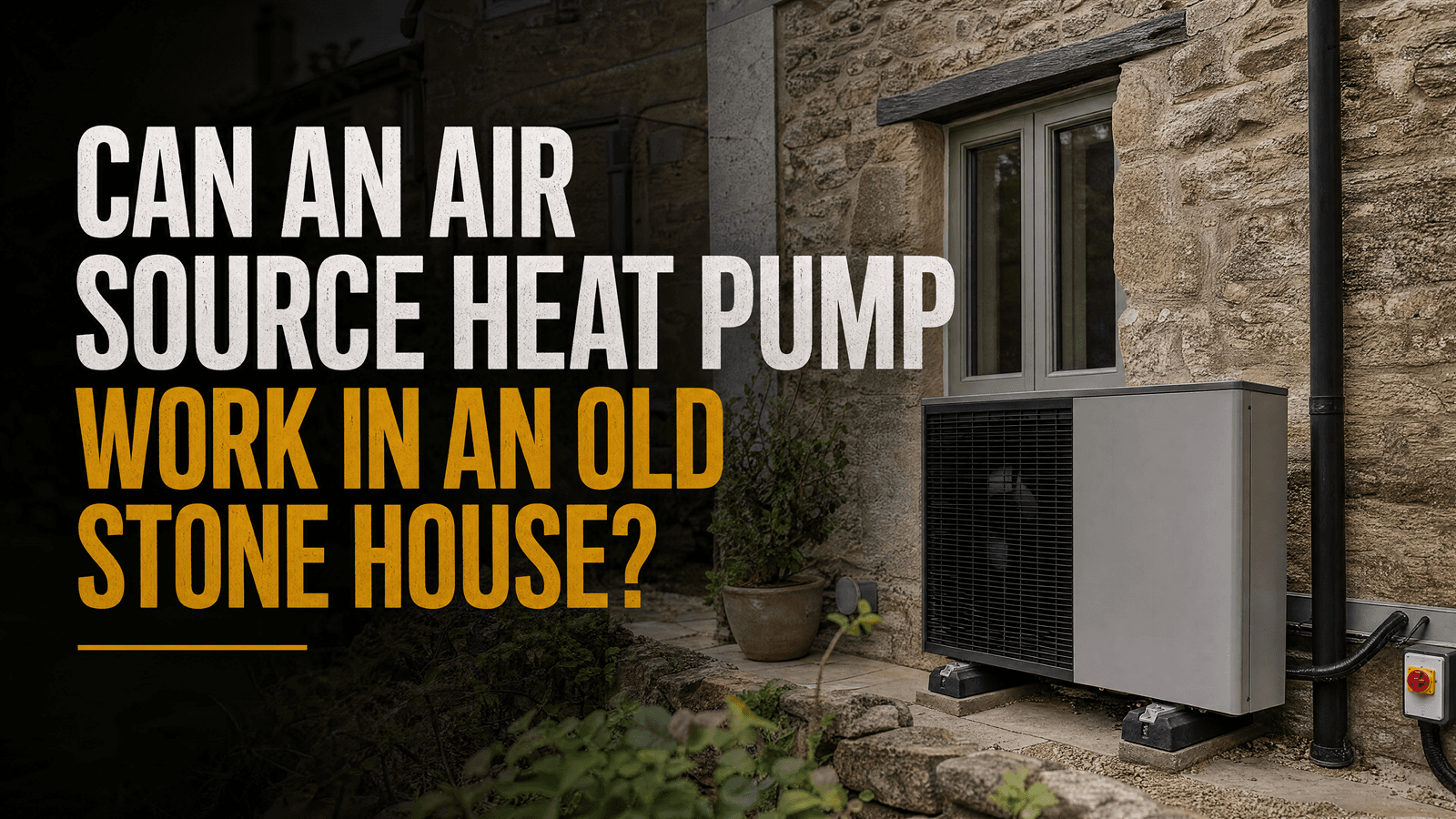
If you live in a stone cottage, a farmhouse or a gritstone terrace, you've probably been told at some point that heat pumps are only for new builds. It's one of the most repeated bits of heating advice going, and it isn't quite right.
An air source heat pump can heat an old stone house well. What it can't do is make up for a house that loses heat faster than it can replace it. Whether it works for your home comes down to a handful of things you can measure: how much heat the building loses, whether the walls are dry, what insulation can safely go in, whether your radiators can run at lower temperatures, and where the outdoor unit can sit.
Get those right and a stone house can be a perfectly good home for a heat pump. Get them wrong and the bills will disappoint, which is why we'd always rather tell you "not yet" than sell you something that struggles.
Adam here. I set up Eco Heat Surge with Danny, and installations are my side of the business. I've installed a heat pump in a stone-built home myself, and we cover Penistone and its surrounding villages, where older stone-built properties make up most of the housing. This guide is what I'd want you to know before you spend any money.
Why stone houses have a reputation for being hard to heat
Most stone houses built before about 1920 have solid walls. The Energy Saving Trust's guide to solid wall insulation makes the same point, while noting that some newer stone buildings do have modern cavity walls. Around Penistone, we also come across single-skin walls in older properties, which lose heat even more readily.
A solid wall has no cavity to fill, so heat passes through it more easily than through a modern insulated wall. That matters more for a heat pump than for a boiler, and here's why.
A gas or oil boiler sends very hot water to your radiators. A heat pump works most efficiently sending cooler water, which it does over longer periods. If the house leaks heat quickly, the heat pump has to run hotter to keep up, and the hotter it runs, the less efficient it becomes. So the question isn't really "is it stone?" It's "how much heat does this particular house lose, and what can we do about it?"
Altitude plays a part too. Penistone sits at around 800ft, higher than most of South Yorkshire, so winters up there are colder, and the system needs sizing for that.
It starts with a proper heat loss survey
Nobody can tell you whether a heat pump suits a stone house from a photo or a postcode. It has to be measured.
This is how we approach it:
- A free suitability call. We ask about the property, the insulation, your hot water use and the outdoor space. If a heat pump clearly isn't right, we say so on the phone and you don't need a survey.
- An on-site survey that calculates heat loss for every room. This tells us how much heat each room needs on a cold day, which decides the size of the heat pump and whether each radiator can cope.
- A radiator review. We check every existing radiator against what its room needs at a lower water temperature, and resize where needed.
- Agreeing the outdoor unit position with you, and checking the electrical supply can take a heat pump.
- A detailed written quote within a week of the survey.
If you want the wider picture first, my earlier guide weighing up heat pumps for South Yorkshire homes covers the general pros and cons. This article sticks to what's different about stone.
Insulating stone walls without causing damp
This is where stone houses need the most care, and where the wrong advice does real damage.
Traditional walls built from stone and lime are good at handling moisture. They take it in and let it out again. Seal them up with the wrong materials and that moisture can get trapped inside the wall, which leads to damp, decay and a colder house, the opposite of what you wanted.
The Energy Saving Trust's guidance is clear on the main points:
- Damp comes first. Wall insulation shouldn't go in until any existing damp problems are fixed and the walls are structurally sound.
- Internal insulation carries a moisture risk. It makes the wall itself colder, so moisture can build up inside it. Permeable, breathable materials help avoid that.
- External insulation doesn't eat into your rooms, but it does cover the outside of the wall.
- Ventilation must stay. Airbricks, wall vents and trickle vents are there for a reason and shouldn't be blocked.
On a stone house, covering the outside also changes its character, which is a big decision in its own right and can be a planning question in a conservation area.
We're heating engineers, not insulation installers. What we will do is show you where the heat is going, because the survey makes that obvious. If the walls need attention, a specialist who understands traditional buildings is the right person for that part.
The good news is that walls aren't the only place heat escapes. Loft insulation and decent glazing are the basics we look for on any heat pump job, and in a lot of stone homes they're simpler to sort than the walls.
Radiators, flow temperature and the hot water cylinder
Because a heat pump runs cooler water, a radiator gives out less heat than it did with your boiler. In a stone house with small original radiators, some of them will usually need to be larger. That's normal, and the room-by-room survey works out exactly which ones.
You'll also need space for a hot water cylinder. Our heat pump installs include one, from a 200 litre cylinder in a modest home to 250 litres in a typical family house, and more for larger properties. In a cottage with no airing cupboard, finding that space is often the biggest practical puzzle, so it's worth thinking about early.
Most of our heat pump installs take three to five days, with floors and carpets protected throughout.
Planning permission, listed buildings and conservation areas
For most houses in England, an air source heat pump counts as permitted development, which means no planning application, as long as it meets certain conditions. The Planning Portal's air source heat pump guidance sets these out in full. The ones that tend to catch out stone properties are:
| Your situation | What the Planning Portal says |
|---|---|
| Listed building | Permitted development rights don't apply, so you'll need listed building consent |
| Conservation area | The unit can't go on a wall or roof facing a highway, or sit closer to that highway than the house itself |
| Any house | The outdoor unit, including its housing, can't exceed 1.5 cubic metres |
In practice, a conservation area usually means the unit goes on a rear or side wall. There are conservation areas around here, including Cawthorne, and parts of central Penistone bring listed building and conservation area constraints too. If you're not sure whether your home is affected, check with Barnsley Council before anything is booked. We'll factor it into the survey either way.
Stone homes on heating oil: the grant is bigger
Not every stone house on the rural fringe is on mains gas. Some properties, especially towards Thurlstone, Hoylandswaine and Cawthorne, run on heating oil instead.
That matters for the government's Boiler Upgrade Scheme. According to gov.uk's grant amounts, the scheme is worth £7,500 on an air source heat pump install, and until March 2027 there's an extra £1,500 if your home is heated by oil or LPG and has no mains gas connection. Two things to know before you plan around it:
- The grant has to be applied for by an MCS certified installer, so check any installer's certification before you rely on the money.
- Hybrid systems don't qualify. A heat pump working alongside a boiler can't get the grant.
For how running costs compare once a heat pump is in, our guide to heat pump and boiler running costs goes through the numbers that matter.
When a heat pump isn't the right answer yet
Honesty matters more here than anywhere, because a heat pump in the wrong house is an expensive mistake.
A heat pump in a solid-walled house with no insulation will still run, but the bills are likely to disappoint. If that's your situation, the better order is usually to sort the damp and insulation first, then revisit. If the walls are damp or the property can't be improved for now, it's worth waiting.
Sometimes the most sensible step today is a new, efficient boiler, with a heat pump planned for later. That's work we do in stone houses too. On one Penistone stone cottage, we replaced a 16-year-old combi with an Ideal Vogue Max, moving it into the utility room and routing a new flue through the stone gable. If that's where you land, our boiler installation service covers how we quote.
Getting a straight answer for your stone house
A stone house isn't a reason to rule out a heat pump, and it isn't a guarantee one will work. It's a reason to measure carefully first.
If you'd like to know where your home stands, start with a free suitability call about our air source heat pump installations. Our Penistone and villages page shows which places we reach. Ring 01226 885022 and you'll speak to Danny or me. If a heat pump isn't the right fit for your house, we'll tell you on that first call.
Frequently asked questions
Can an air source heat pump heat an old stone cottage?
Yes, if the house is ready for it. What matters is how much heat the building loses, whether the walls are dry, what insulation can safely be added, and whether the radiators can work at lower water temperatures. A room-by-room heat loss survey shows whether a heat pump will keep your home warm at a sensible running cost.
Do I need to insulate stone walls before fitting a heat pump?
Not always, but a solid-walled house with no insulation is likely to give disappointing bills. Start with loft insulation and glazing. If the walls need insulating, any damp must be fixed first, and breathable materials should be used, because the wrong insulation can trap moisture inside a stone wall.
Do I need planning permission for a heat pump on a listed stone house?
Yes. Permitted development rights don't apply to listed buildings, so you'll need listed building consent. In a conservation area, the unit generally can't go on a wall or roof facing a highway. For most other houses in England, a heat pump is permitted development if it meets the Planning Portal's conditions.
Will I need bigger radiators in a stone house?
Often, yes. A heat pump sends cooler water to the radiators than a boiler does, so each radiator gives out less heat. Older stone houses frequently have small original radiators. A room-by-room survey shows which ones can stay and which need replacing with larger ones.
Is there a bigger heat pump grant for homes on heating oil?
Yes. Gov.uk lists £7,500 for an air source heat pump under the Boiler Upgrade Scheme, plus an extra £1,500 until March 2027 if your home is heated by oil or LPG and has no mains gas connection. The grant must be applied for by an MCS certified installer.
Can I get the grant for a hybrid heat pump system?
No. Gov.uk states that hybrid systems, such as a heat pump working with a gas boiler, can't get the Boiler Upgrade Scheme grant. A hybrid can still suit some homes, but you would pay for it without the grant, so it's worth factoring that into any comparison.
Get more like this
One honest email a month.
Boiler tips, heat pump advice, and answers to the questions our customers actually ask.
Curious about a heat pump?