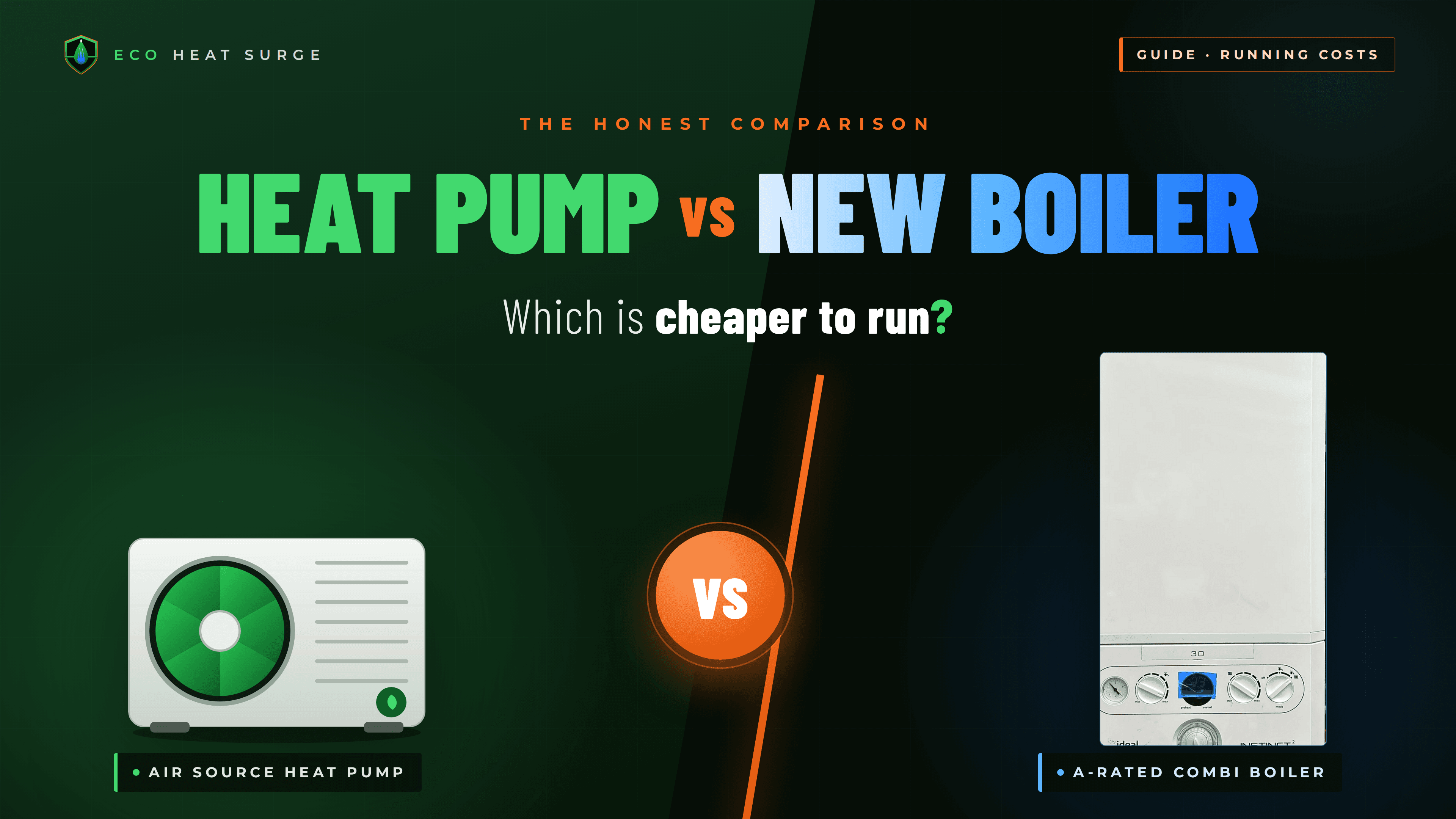
Heat pump or new gas boiler? It is the question more South Yorkshire homeowners are asking, usually with one real worry underneath it: which one actually costs less to run. The honest answer up front is that a heat pump can match or beat a gas boiler on running costs, but only in the right home, and it costs more to fit before the grant.
Whether it works out cheaper for you comes down to your insulation, your radiators and the gap between gas and electricity prices. Let me pull the real cost picture apart so you can see where each one wins.
I'm Adam, one of the founders of Eco Heat Surge, and I fit both gas boilers and air source heat pumps across South Yorkshire. That means I have no reason to push you either way, only to give you the straight comparison.
Two systems that cost money very differently
A gas boiler makes heat by burning gas. A heat pump does not make heat at all; it moves it, pulling warmth out of the outside air and concentrating it to heat your home, using electricity to run the process.
That single difference is why their running costs behave so differently, and why you cannot compare them on fuel price alone.
Efficiency is the whole game
This is the part that trips everyone up, so it is worth slowing down on.
A modern condensing gas boiler is around 90% or more efficient. Burn a unit of gas and you get most of it back as heat. Good, but you never get more out than you put in.
A heat pump is different, because it is moving heat rather than making it. For every unit of electricity it uses, it typically delivers three to four units of heat, an efficiency of 300 to 400%.
The Energy Saving Trust covers this in its guide to air source heat pumps.
Here is the catch that keeps it honest: electricity currently costs roughly three to four times as much as gas per unit. So the heat pump's big efficiency advantage is largely cancelled out by the higher price of the fuel it runs on. Whether it comes out ahead depends on how efficiently it can run in your specific home.
Head to head, at a glance
| Gas boiler | Air source heat pump | |
|---|---|---|
| How it heats | Burns gas | Moves heat using electricity |
| Efficiency | Around 90% or more | Roughly 300 to 400% |
| Fuel cost per unit | Lower (gas) | Higher (electricity) |
| Upfront cost | Lower | Higher, but the grant helps |
| Government grant | None | £7,500 Boiler Upgrade Scheme |
| Typical lifespan | Around 10 to 15 years | Around 15 to 20 years |
| Best suited to | Most existing homes | Well-insulated homes, low flow temperatures |
| Carbon footprint | Higher | Lower, and falling as the grid greens |
Upfront cost: where the boiler wins today
There is no getting around it, a new gas boiler is the cheaper thing to fit. Our fixed-price installs start from £1,600, and it is a well-understood, one-day job in most homes.
A heat pump costs more to install, because it is a bigger system with an outdoor unit, and it often needs radiator or emitter changes to run efficiently. What changes the maths is the £7,500 Boiler Upgrade Scheme grant, which is deducted straight off the price by a certified installer. That grant does a lot of heavy lifting to close the upfront gap.
Running cost: the part that depends on your home
This is where I have to be straight, because the heat pump adverts are not always. A heat pump only delivers its best efficiency when it can run at a low flow temperature, gently warming a well-insulated home through suitably sized radiators or underfloor heating.
In a home like that, a heat pump can run at or below the cost of a gas boiler while cutting carbon significantly. In a draughty, poorly insulated home with small radiators, the same heat pump has to work harder, its efficiency drops, and the running costs can disappoint.
That is the single biggest reason two people give completely different verdicts on heat pumps: their homes were different, not the technology.
The things that actually move your running cost
With a heat pump especially, the number on your bill is decided long before the unit is switched on. The main levers are:
- Insulation. The better your home holds heat, the less the system has to produce, and this matters far more for a heat pump than a boiler.
- Flow temperature and radiator size. A heat pump is at its most efficient running warm rather than hot, which usually means larger radiators or underfloor heating to give out the same heat.
- Your electricity tariff. Because a heat pump runs on electricity, a heat-pump-friendly or time-of-use tariff can make a real difference to the running cost. It is worth shopping around once you have one.
- How you run it. Heat pumps like to be left ticking over at a steady temperature, not blasted on and off like a boiler. Run one like a boiler and you will pay for it.
- The quality of the design. An undersized or badly commissioned system will always cost more to run. This is where a proper survey earns its keep.
What about a hybrid system?
There is a middle option that often gets overlooked. A hybrid system pairs a heat pump with a gas boiler, letting the heat pump do the everyday heating and the boiler step in on the coldest days or for a fast blast of hot water.
It can be a sensible stepping stone for a home that is not quite ready to go fully electric, though it is a more complex setup with two systems to maintain. Whether it makes sense is very much a survey conversation, not a one-size-fits-all answer.
Lifespan and maintenance
Both systems want an annual service to stay safe, efficient and in warranty, so upkeep is broadly similar year to year. Where they differ is longevity. A gas boiler typically gives you 10 to 15 years. A well-installed heat pump often runs 15 to 20, so although it costs more at the start, it is spreading that cost over a longer life.
So which is cheaper for your home?
The honest verdict is that it depends, and anyone who gives you a flat answer without seeing your home is guessing.
If your home is reasonably insulated, or you are willing to improve it, and you like the idea of lower carbon and the £7,500 grant, a heat pump makes a genuinely strong case on lifetime cost.
If your home is older and harder to insulate, or you simply need the lowest upfront price today, a modern gas boiler is often still the more economical choice for now. For a fuller look at the non-cost side of the decision, our deeper piece on whether a heat pump is worth it in South Yorkshire digs into that.
Getting a straight answer for your own home
The only way to really know is to have someone look at your property, your insulation and your radiators, and run the numbers for you rather than for an average house. That is exactly what our survey does, with no pressure either way.
Compare our air source heat pump service with our boiler installation service to see how we approach each, or get in touch for honest advice on which one actually stacks up for your home.
Frequently asked questions
Is a heat pump cheaper to run than a gas boiler?
It can be, but not automatically. A heat pump is far more efficient than a boiler, yet electricity costs more than gas per unit, so the two roughly offset. In a well-insulated home running at a low flow temperature, a heat pump can match or beat a boiler. In a draughty home, it may cost more.
Why is a heat pump more efficient than a boiler?
A boiler makes heat by burning gas, so it can never return more energy than it uses. A heat pump moves existing heat from the outside air rather than making it, delivering around three to four units of heat for every unit of electricity. That is why its efficiency is measured in hundreds of per cent.
Does a heat pump cost more than a new boiler?
Yes, to install. A new gas boiler starts from around £1,600 fitted, while a heat pump is a larger system that costs more upfront and may need radiator changes. The £7,500 Boiler Upgrade Scheme grant closes much of that gap for eligible homes, which changes the comparison considerably.
How long does a heat pump last compared to a boiler?
A gas boiler typically lasts around 10 to 15 years, while a well-installed heat pump often runs 15 to 20. Both need an annual service to stay efficient and in warranty. The heat pump costs more at the outset but spreads that cost over a longer working life.
Do I need to change my radiators for a heat pump?
Often, yes. A heat pump runs at a lower flow temperature than a boiler, so existing radiators sometimes need upsizing to give out the same heat, or underfloor heating can be used instead. A proper survey works this out room by room, and it is central to how efficiently the system will run.
What is a hybrid heat pump system?
A hybrid pairs a heat pump with a gas boiler. The heat pump handles everyday heating while the boiler steps in on the coldest days. It can suit a home not quite ready to go fully electric, though it means two systems to maintain. Whether it is worthwhile is a survey decision.
Get more like this
One honest email a month.
Boiler tips, heat pump advice, and answers to the questions our customers actually ask.
Curious about a heat pump?