You've seen the adverts: control your heating from your phone, let it learn your routine, watch the bills fall. Then you look at the price of a smart thermostat and wonder whether it's a genuine upgrade or just a nicer-looking dial on the wall.
So, are smart thermostats worth it? For a lot of homes, yes, but the saving depends almost entirely on how you run your heating now. The Energy Saving Trust puts it the same way: whether smart controls save you money comes down to how you currently control your heating. If the heating often runs while nobody's in, your days don't follow a set pattern, or you want different rooms warm at different times, a smart system can make a real difference. If you're home most of the day and already use a programmable thermostat well, the gain is much smaller.
I'm Danny from Eco Heat Surge. Every new boiler we fit comes with a Hive, Nest or Tado smart thermostat, set up and explained before we leave, so I've set a fair few of them up. Here's how I'd weigh it up for your home.
What does a smart thermostat actually do?
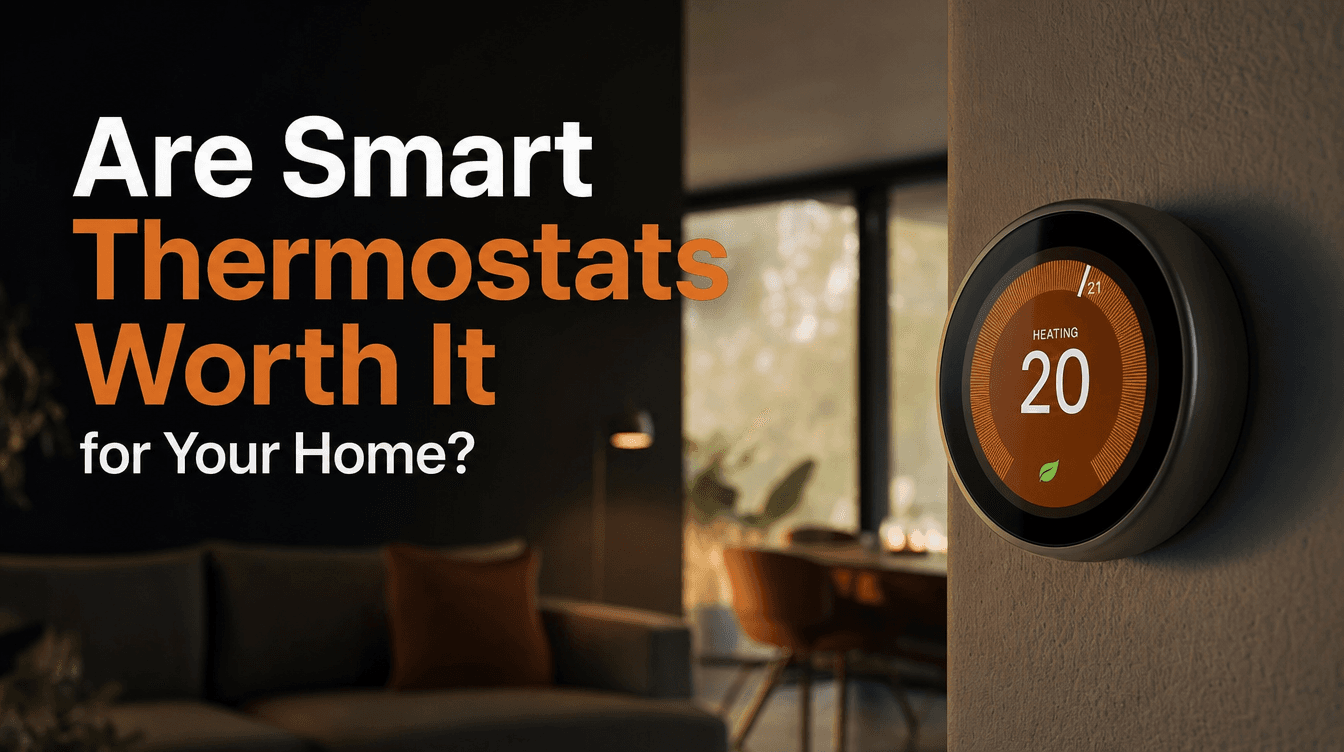
A smart thermostat does everything a normal room thermostat and programmer do. It switches the heating on and off to a schedule and holds the house at the temperature you've chosen. The difference is that it's connected to the internet, which opens up extra features.
According to the Energy Saving Trust's advice on heating controls, those features can include:
- An app on your phone to change the temperature or switch the heating off while you're out
- Easier scheduling, with a clear screen for setting heating and hot water times
- Learning your habits and adjusting itself to match
- Geo-fencing, which uses your phone's location to turn the heating down when everyone's left and back up before you get home
Most of these are optional. If you don't like the idea of location tracking, you can switch it off and still use the rest.
Smart thermostat vs standard heating controls
It helps to see where a smart thermostat sits among the other controls on a typical gas heating system.
| Control | What it does | Worth knowing |
|---|---|---|
| Programmer or timer | Sets when the heating comes on and off | Every system should have one |
| Room thermostat | Holds the house at a set temperature | Turns the boiler off once the room is warm enough |
| Programmable room thermostat | A timer and thermostat in one unit | Can set different temperatures for different times |
| Thermostatic radiator valves (TRVs) | Control the heat from each radiator | Let you run spare rooms cooler |
| Smart thermostat | A programmable thermostat you control by app | Adds remote control, learning and geo-fencing |
| Smart or programmable TRVs | TRVs with their own timings, often linked by Wi-Fi | Can turn each room into its own zone |
| Weather or load compensation | Adjusts how hot the boiler runs to match conditions | Helps the boiler run more efficiently |
The Energy Saving Trust recommends that a gas, oil or LPG central heating system has, at minimum, a programmer, at least one room thermostat and TRVs. A smart thermostat covers the first two. It doesn't replace TRVs, which still matter for room-by-room control.
How much can a smart thermostat save?
This is where you need to be careful with the numbers you read online. Figures vary widely, and many come from manufacturers or trade bodies with an interest in selling controls.
The most reliable independent figures I know of come from the Energy Saving Trust. Its estimate is that installing heating controls and using them well could save around £100 a year in Great Britain. It also says that turning your thermostat down by one degree, from 22°C to 21°C, could save around £120 a year. Those figures are for heating controls in general and for good habits, not for a smart thermostat on its own.
What a smart thermostat does is make those good habits easier to stick to. It's harder to forget to turn the heating off when your phone reminds you, and the schedule is easier to adjust when your week changes. The saving comes from the heating running less when it isn't needed, not from the thermostat itself.
When a smart thermostat is worth it
In my experience, these are the homes that get the most out of one:
- Your routine changes from week to week, with shifts, part-time hours or kids between two houses
- The house is often empty during the day, but the heating comes on anyway
- You go away regularly and want to switch the heating back on before you get home
- You want to control rooms separately, by adding smart TRVs so bedrooms and spare rooms aren't heated all day
- You're getting a new boiler anyway, when a smart thermostat usually comes as part of the job
When it might not be
A smart thermostat is a smaller win if:
- Someone's at home most of the day and the heating needs to be on anyway
- You already use a programmable thermostat and keep the schedule tight
- Your Wi-Fi doesn't reach the spot where the thermostat or its hub needs to go
- The bigger problem is the system itself, such as cold radiators, sludge or a boiler that's struggling, which no thermostat will fix
That last one matters. If rooms never get properly warm, look at the radiators and the boiler first. A smart thermostat controls the heat you've got. It can't create heat the system isn't delivering.
Do you need a smart thermostat with a new boiler?
You might, depending on the boiler. Since April 2018, under the government's Boiler Plus standards, any new gas or oil boiler installed in an existing home in England must have a timer and a room thermostat. When the new boiler is a combi, one extra energy-saving measure is required on top. The options are:
- Flue gas heat recovery
- Weather compensation
- Load compensation
- Smart controls featuring automation and optimisation
Not every thermostat with an app meets that last description, so it's the installer's job to make sure what's fitted qualifies. On our side, a smart thermostat is included in our combi-to-combi swaps, which start from £1,600, and in our conversions from a system or regular boiler to a combi, which start from £2,400. The details are on our pricing page, and our boiler installation service explains what else comes with every install.
If you're still deciding between boiler types, our guide on whether a combi or system boiler suits your home is a good place to start, as the type affects which controls you'll need.
Getting the most out of your smart thermostat
A smart thermostat only saves money if it's set up well. The Energy Saving Trust sets out a sensible starting point:
- Set the main temperature to the lowest you're comfortable with. For most people that's between 18°C and 21°C.
- Set a lower temperature for nights and time out. The Energy Saving Trust suggests somewhere around 12°C to 15°C for many homes, but keep it higher if anyone in the house is vulnerable to the cold or spends long periods at home.
- Don't turn it up on cold days. The house heats to the same temperature either way. If it's slow to warm up, bring the heating on a little earlier instead.
- Set every TRV to the lowest setting that keeps each room comfortable. Spare rooms can run cooler, but it's better to keep a little background heat than none, to help avoid condensation and mould.
- Keep radiator covers away from TRVs. A cover traps warm air around the valve, so it thinks the room is warmer than it is and shuts off too early.
One more setting is worth a look: your boiler's flow temperature, which is how hot the water leaving the boiler is. The Energy Saving Trust says that if it's set higher than needed, lowering it can save money, because cooler water coming back to the boiler helps it work more efficiently. There's a catch, though. Where the boiler also heats a hot water cylinder, as system and regular boilers do, it shouldn't go below 65°C, so the cylinder can still reach 60°C and stay free of harmful bacteria. If you don't know which type is on your wall, mention it at your next boiler service.
Smart TRVs and zoning
A smart thermostat on its own controls the whole house from one spot, usually the hallway or living room. That's fine for a lot of homes, but it means the bedrooms get heated whenever the living room does.
Smart TRVs fix that. Each one runs its own schedule, so a radiator only comes on when that room is actually used. Linked to the thermostat, every room can become its own zone. The alternative on a system or regular boiler is proper zone valves, with separate upstairs and downstairs circuits.
We fit multi-zone setups from Hive, Nest, Tado and Honeywell as a regular part of the central heating jobs we take on, and we commission them properly rather than just plugging them in. For a rough idea of what controls cost more generally, the Energy Saving Trust estimates around £600 to add a programmer, thermostat and TRVs to a home with none, or around £370 to add TRVs to every radiator where you already have a programmer and thermostat.
Looking after it once it's fitted
Smart thermostats are low-maintenance, but they still rely on talking to the boiler. On every service, part of our check is making sure the thermostat and boiler are communicating reliably, and our guide to what happens during an annual boiler service runs through the full list.
So, is it worth it for you?
If your heating runs more than it needs to, your routine is unpredictable, or you're replacing your boiler anyway, a smart thermostat is usually a sensible buy. If you're home all day and already on top of your schedule, spend the money on TRVs or a boiler service first.
Either way, we're happy to talk it through. Ring 01226 885022 (the phones are staffed 8am to 5pm on weekdays) or drop us a message, and Adam or I will point you towards whatever would genuinely help in your home.
Frequently asked questions
Do smart thermostats really save money?
They can, but it depends on how you control your heating now. The Energy Saving Trust estimates that installing and using heating controls well could save around £100 a year in Great Britain. Smart thermostats help most where the heating runs in an empty house or your routine varies. With a tight schedule already, the gain is smaller.
Does a new combi boiler need a smart thermostat?
Not necessarily a smart one. Since April 2018, the Boiler Plus standards in England require a timer and room thermostat with every new gas boiler, plus one extra measure for a combi. Smart controls with automation and optimisation are one option; weather compensation, load compensation and flue gas heat recovery are the others.
What temperature should I set my smart thermostat to?
The Energy Saving Trust suggests the lowest temperature you find comfortable, which for most people is between 18°C and 21°C. For nights or time away, many homes can drop to around 12°C to 15°C. Keep it warmer if anyone in the house is elderly, unwell or vulnerable to the cold, as comfort and health come first.
Are smart radiator valves worth adding?
They're worth it if different rooms are used at different times. Smart TRVs let each radiator run its own schedule, so bedrooms or a spare room aren't heated all day just because the living room is. They're often the most practical way to add room-by-room zoning without changing the pipework in an existing system.
Will a smart thermostat work with my boiler?
Most modern gas boilers can run with a smart thermostat, but compatibility depends on the boiler, the controls it already has and whether it's a combi or has a hot water cylinder. Check the thermostat maker's guidance, or ask your heating engineer to confirm before you buy, so you don't end up with something that can't be wired in.
Can a smart thermostat fix rooms that never get warm?
No. A thermostat controls when the heating runs and how warm the house gets, but it can't make a radiator produce heat it isn't delivering. Cold radiators, sludge in the system or a struggling boiler need looking at directly. Sort those out first, then a smart thermostat will control a system that actually works properly.
Get more like this
One honest email a month.
Boiler tips, heat pump advice, and answers to the questions our customers actually ask.
Heating not quite right?