It starts as a faint crackle when the heating comes on. A few weeks later it's a proper rumble, and some mornings the boiler sounds exactly like a kettle coming to the boil. That comparison is where the name comes from, and it's closer to the truth than most people realise.
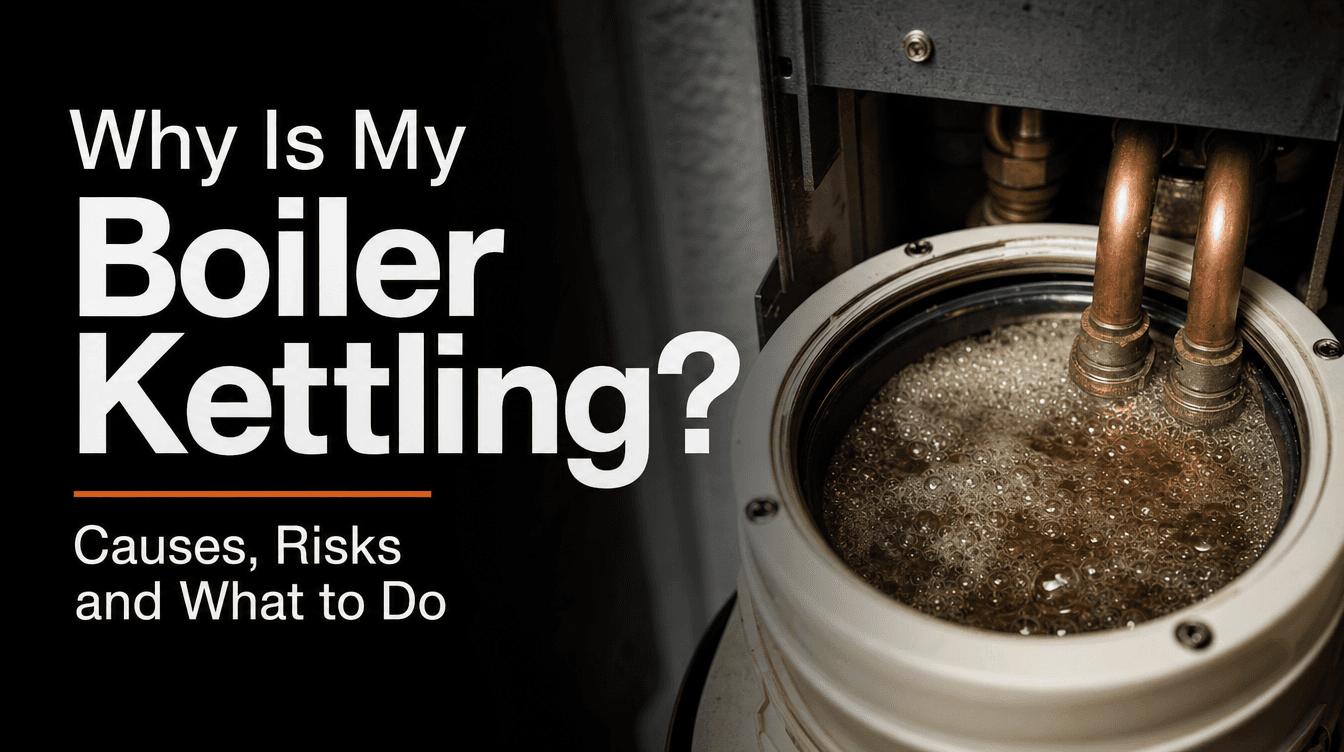
Boiler kettling means water is actually boiling inside your boiler. Normally water moves through the heat exchanger fast enough to warm up without ever reaching boiling point. When something slows it down, a little of it flashes into steam, and the bubbles collapse with that rumbling, popping sound.
In most homes the cause is one of four things: limescale on the heat exchanger, sludge in the system, a failing pump, or a faulty thermostat or sensor. It's rarely an emergency on the day, but it's a warning worth acting on, because a boiler that keeps boiling its own water is putting real strain on its most important parts.
Danny writing. Adam and I run Eco Heat Surge between us and turn up to every job ourselves, so this is the explanation you'd get if you rang us about a noisy boiler.
Before anything else: if you ever smell gas, don't use switches or sockets, open the windows, get everybody out of the house and phone the national gas emergency number on 0800 111 999. National Gas explains the steps on its gas safety and emergencies page. Kettling on its own isn't a gas leak, but that advice always comes first.
What causes a boiler to kettle?
Every cause comes back to the same problem. Water is sitting in the hottest part of the boiler for longer than it should, either because something is blocking its path or because the boiler is running hotter than it's meant to.
Ideal, one of the two boiler brands we're approved to install, lists the same causes in its own guide on whether kettling is dangerous. Here's how they usually show themselves.
| Likely cause | What tends to go with it | The usual fix |
|---|---|---|
| Limescale on the heat exchanger | Hard water area, a system that's been topped up a lot over the years | Cleaning the heat exchanger, or replacing it if the damage is done |
| Sludge restricting flow | Radiators cool along the lower half, dark water when you bleed them | Power flushing, then a magnetic filter |
| A failing pump | Rooms slow to warm, radiators that never get properly hot | Replacing the pump |
| A faulty thermostat or sensor | The boiler overheating and locking out, often with a fault code | Replacing the faulty part |
Limescale
Hard water carries dissolved minerals, and heat makes them drop out as scale. Inside a boiler, that scale coats the heat exchanger's waterways, narrowing them and insulating the metal. The water that does get through picks up heat too quickly and starts to boil.
A sealed heating system shouldn't pick up much scale, because the same water goes round for years. The trouble comes when it keeps getting refilled, because each top-up adds fresh mains water, and in a hard water area that water brings more minerals with it. That's one more reason a system that keeps losing pressure needs its leak finding. Our guide to a boiler that keeps losing pressure covers how to track that down.
Sludge
Steel radiators corrode slowly from the inside, and the rust becomes a black sludge that drifts round the system. It collects in the narrowest passages, and few passages are narrower than the ones inside a modern heat exchanger. Less flow means hotter water, and eventually boiling water.
If sludge is the culprit, you'll usually spot it elsewhere too: radiators with cool patches lower down, or murky water when you bleed them. A whole-system power flush with us starts from £495 including VAT, and our guide to what a power flush costs and when it is worth paying for explains what a proper one should include.
A failing pump
The pump is what keeps water moving through the boiler and round the house. As it wears, it pushes less water, and the water left sitting in the heat exchanger overheats. A tired pump often shows up as heating that takes ages to warm the house before any noise starts.
A faulty thermostat or sensor
Your boiler relies on temperature sensors to know when to ease off the burner. If one of them misreads, the boiler can keep firing when the water is already hot enough. Modern boilers usually catch this and shut down to protect themselves, which is why a thermostat fault often looks like a boiler that kettles and then locks out.
Is a kettling boiler dangerous?
Usually not in the immediate sense, but it's not something to live with either. Ideal's own advice is that kettling can be dangerous in theory, because the pressure it creates could burst internal pipework, and that modern boilers are built with safeguards to spot overheating and shut down before it gets that far.
In practice, what we find is damage rather than danger. A boiler that kettles for months is putting its heat exchanger through repeated overheating, and that's the component you least want to replace. Scale and sludge also drag down the boiler's efficiency, which you end up paying for on your gas bill.
Switch the boiler off and call an engineer straight away if:
- The noise turns into loud, violent banging rather than a rumble
- You can see water or steam coming from the boiler or its pipework
- The boiler keeps locking out and the fault returns every time you reset it
If none of those apply, you can carry on running the heating until someone has had a look. Just don't leave it for the whole winter.
Checks you can make before you ring
None of these involve taking the boiler case off, and nothing on this list needs tools. Anything behind the casing needs someone on the Gas Safe Register.
- Notice when the noise happens. Only when the heating first fires up, all the time, or only when you run the hot tap? That detail genuinely helps pinpoint the cause.
- Read the pressure gauge with the system cold. A cold reading of roughly 1 to 1.5 bar is normal. If you've been topping it up regularly, mention it.
- Photograph any fault code on the display, plus the label showing your boiler's make and model.
- Bleed a radiator or two if they're cooler at the top. If the water that comes out is black, that points towards sludge.
- Think about the boiler's age and history. How old it is, when it was last serviced and whether it has ever had a system flush are all useful to know.
Please don't try descaling products or chemical treatments yourself hoping to quieten it down. Getting the cause wrong can make things worse, and it won't tell you whether the pump or a sensor is the real problem.
How we fix a kettling boiler
The first job is finding out which cause you've actually got, because the fixes are completely different. There's no point flushing a system when the pump is the problem, and no point swapping a pump when the heat exchanger is furred up with scale.
When you phone, you'll hear what the callout costs up front. That figure depends on where you live and when you need us. After diagnosis you get a written price for the repair, and if you choose to go ahead, the callout charge is deducted from it. Our boiler repair page lists typical repair times. As a guide, a pump replacement normally takes 1.5 to 2 hours, and a full system flush with a repair usually runs to 4 to 6 hours.
Sometimes the honest answer is that repairing isn't worth it. If the heat exchanger is badly damaged on a boiler that's already well into its second decade, we'll lay out the repair cost against replacing it and let you decide. Our article on the signs a boiler is near the end of its life is a good read if you're weighing that up.
Why we hear more kettling in some parts of South Yorkshire
Water hardness isn't the same everywhere round here. On the Pennine side of Barnsley, the water tends to be softer. Head east over the magnesian limestone around Cudworth and Darfield, or north towards Royston, and it's noticeably harder, and boilers there scale up faster as a result. It's the first local issue we mention on our Cudworth heating page, and we see the same pattern down through the Dearne Valley.
If you're not sure how hard your water is, Yorkshire Water has a postcode checker for water hardness. Knowing you're in a hard water area doesn't mean your boiler will kettle, but it does mean regular servicing matters more.
Stopping it coming back
Once the cause is fixed, a few habits keep a boiler quiet for years:
- Book an annual service. Checking and cleaning the heat exchanger is part of every boiler service we carry out, which is where early scale gets caught.
- Keep a magnetic filter on the system. It traps sludge before it reaches the boiler. We fit one as standard on every new installation.
- Keep the inhibitor topped up. Corrosion inhibitor slows down the rusting that creates sludge in the first place.
- Fix leaks rather than living with them. A system that holds its pressure isn't constantly drawing in fresh hard water.
If your boiler has started to rumble, crackle or whistle, don't wait for it to lock out on the first cold night. Call us on 01226 885022 and you'll get Adam or me, not a call centre. We'll find out why your boiler is kettling and give you a straight answer on the best fix.
Frequently asked questions
What does boiler kettling sound like?
Kettling sounds like a kettle coming to the boil: a low rumble, crackling or popping, sometimes rising to a whistle or light banging. It happens while the boiler is firing and heating water. The sound is steam bubbles forming and collapsing inside the heat exchanger.
Is it safe to use my boiler if it is kettling?
In most cases you can keep using it while you arrange a repair, because modern boilers are designed to shut down if they overheat. Switch it off and call an engineer straight away if the noise becomes violent banging, you see water or steam, or it keeps locking out with the same fault code.
Can a power flush stop a boiler kettling?
It can, when sludge is what's restricting the flow. A power flush clears the sludge and a magnetic filter stops it building up again. It won't help if the real cause is a failing pump, a faulty sensor or heavy limescale on the heat exchanger, which is why the cause needs diagnosing first.
What will a kettling repair cost?
It depends on the cause, so we diagnose before quoting. The callout charge is agreed on the phone first, the repair price comes in writing after diagnosis, and the callout charge is taken off that price if you proceed. For sludge, a whole-system power flush with us starts from £495 including VAT.
Does hard water make boiler kettling more likely?
Yes. Hard water leaves limescale on the heat exchanger, which slows the flow and lets water overheat. Around Barnsley, the water is noticeably harder to the east and north, in places like Cudworth, Darfield and Royston. An annual service catches early scale, and fixing leaks stops the system drawing in more hard water.
Can I fix a kettling boiler myself?
Not safely. The causes sit inside the boiler or the sealed system, so repairs belong with a Gas Safe registered engineer. What you can do is note when the noise happens, check the pressure gauge, write down any fault code and bleed radiators, which all help the engineer diagnose it faster.
Get more like this
One honest email a month.
Boiler tips, heat pump advice, and answers to the questions our customers actually ask.