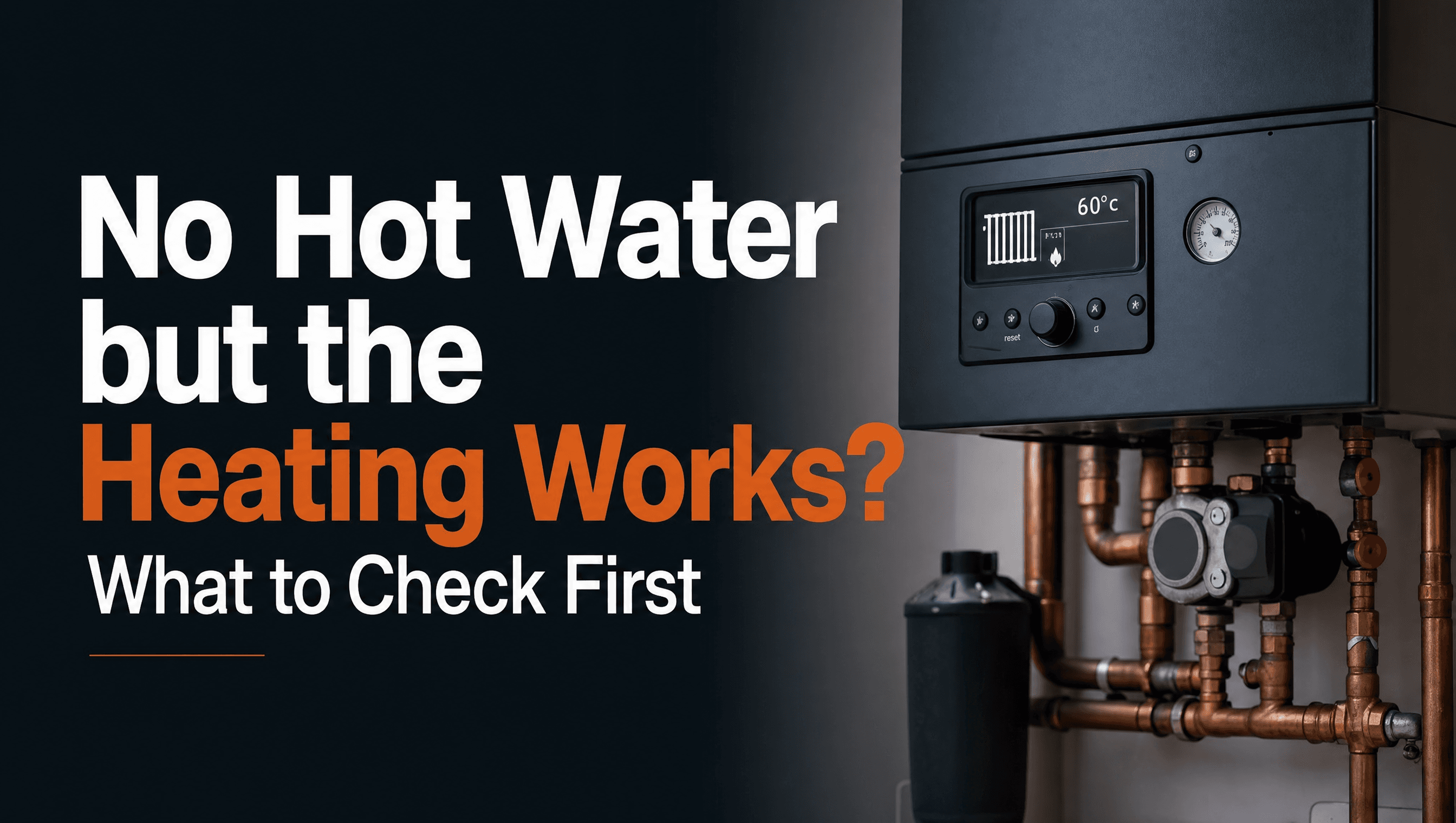
The radiators are warm, the house feels fine, and then somebody turns the shower on and the water never gets past cold. It is a strange one to look at, because the boiler is clearly alive and doing half its job perfectly well.
Here is the answer in one line: heating and hot water leave your boiler by different routes, so a fault on the hot water route alone will leave your radiators completely untouched.
On a combi that usually means the diverter valve, the plate heat exchanger or the hot water sensor. If your hot water is stored in a cylinder, the fault is far more likely to sit in the controls, the cylinder thermostat or a motorised valve.
This guide sorts out which of the two you are dealing with, what tends to fail in each, the checks you can safely make yourself, and the point where it needs an engineer.
Danny here. There are two of us running Eco Heat Surge, both on the tools, and no hot water while the heating carries on is one of the six calls we take most weeks. It is also one of the more satisfying ones, because it is usually a single failed component rather than a poorly boiler.
One thing first, as always. If you can smell gas at any point, do not touch light switches or sockets, get the windows open, get everyone out, and ring 0800 111 999.
National Gas sets out what happens next on its emergency and safety pages. Cold taps alone are never that kind of emergency, but the warning belongs at the top of every one of these guides.
The 60-second check
Try these first. Between them they sort out a good share of cold-tap calls without anyone needing to visit:
- Open a different hot tap. Hot in the bathroom but cold in the kitchen means the boiler is fine and the problem is that one tap.
- Make sure hot water is actually switched on. That means the hot water channel on a programmer, or the hot water dial on the front of a combi.
- Look for a fault code on the boiler display and jot it down with the make and model.
- On a cylinder system, check the thermostat on the tank is set to around 60°C.
Still cold? Then one part has almost certainly failed, and the sections below will help you work out which.
Why the heating works but there is no hot water
Your boiler is really one heat source feeding two separate demands. When the room thermostat asks for heat, hot water is pushed out to the radiators and back again in a sealed loop.
When you open a hot tap, the boiler has to do something quite different: send its heat into fresh water coming off the mains, or into a cylinder full of stored water.
Those two jobs share a burner and very little else. There is a component that decides which of the two gets served, and there are parts that only ever see hot water duty. When one of those fails, the heating side carries on none the wiser.
So a warm radiator is not proof that your boiler is healthy. It is a clue that narrows the search to a handful of parts, which is why this fault is usually quicker to pin down than a boiler that has gone completely dead.
First work out which system you have
Everything below splits along one line: whether your hot water is made on demand or stored in a tank. If you are not sure which you have, go looking for a cylinder, normally a tall insulated tank in an airing cupboard or a loft.
| What you have | Where hot water comes from | What usually fails |
|---|---|---|
| A boiler on the wall and no cylinder anywhere (a combi) | Made instantly from the cold mains as you run the tap | Diverter valve, plate heat exchanger, hot water sensor, restricted mains flow |
| A boiler plus an insulated cylinder in a cupboard (system or regular) | Stored in the cylinder and reheated by the boiler | Programmer schedule, cylinder thermostat, motorised valve, pump, immersion |
For the fuller picture of how the two designs differ, we have written up the choice between a combi and a system boiler separately.
If you have a combi boiler
The diverter valve has stuck
This is the cause we find most often. The diverter valve swings the boiler's attention away from the radiators and onto your hot tap the moment you open it. It spends its whole life switching back and forth, and eventually it sticks.
When it sticks on the heating side, the symptoms are exactly what you are seeing: radiators fine, taps cold. Sometimes you get a half-stuck version instead, where the water goes lukewarm, or runs hot for twenty seconds and then fades away. It is a replaceable part, not a reason to replace a boiler.
Can you fix it yourself? No. The valve sits inside the sealed boiler case, so only a Gas Safe engineer should replace it. Describe the symptoms when you ring and we can usually bring the part with us.
The plate heat exchanger is blocked
The plate heat exchanger is where the boiler's heat crosses over into your tap water. It is a compact stack of thin plates with very narrow waterways, which makes it efficient and also makes it easy to clog with scale or with the black sludge that circulates in a system nobody has ever flushed.
A partly blocked exchanger normally shows up as hot water that is weak and disappointing rather than absent, and it tends to get worse over a few months. The heating stays fine throughout, because the heating side of the exchanger is not the part that is furring up.
Can you fix it yourself? No. It lives inside the boiler. What helps is telling us if the hot water has been getting weaker over a few weeks, because that points straight at the exchanger. One Barnsley customer had exactly that pattern: Danny diagnosed a failed plate heat exchanger, the part was ordered, and it was fitted within a couple of days.
The hot water sensor has failed
Your boiler needs to know the temperature of the water it is sending to the tap, and it uses a small sensor to measure it.
If that sensor fails or starts reading wrongly, the boiler will often refuse to fire for hot water at all rather than risk sending scalding water to an outlet.
This one frequently arrives with a fault code on the display. Write the code down exactly as it appears, along with the make and model, because it saves real time. Most manufacturers publish their codes, including the Ideal homeowner support pages.
Can you fix it yourself? No, but you can speed the repair up. Keep the fault code and the make of boiler to hand when you ring, and avoid resetting it over and over.
Something is throttling the cold water flow
A combi only fires for hot water once enough cold water is actually moving through it. If the flow drops below that threshold, the boiler simply does nothing when you open the tap.
Worth ruling out are a partly closed isolation valve under the boiler, a service valve somebody nudged during other work, a furred-up aerator on the tap itself, or a shower cartridge choked with debris. The tell here is that only one outlet misbehaves, which is why the checks further down start with running more than one tap.
Can you fix it yourself? Often, yes. Unscrew the aerator on the end of the misbehaving tap, rinse out any grit and refit it. If every hot outlet in the house is weak or cold, leave the valves under the boiler alone and give us a call instead.
If your hot water comes from a cylinder
The programmer is set wrong
Systems with a cylinder treat heating and hot water as two separate channels, and they can be timed completely independently. It is genuinely common for the hot water channel to be switched off or running to a schedule nobody remembers setting, especially after a power cut has reset the clock or somebody has been having a fiddle.
Before anything else, look at the programmer and confirm the hot water side is calling. It costs nothing to check and it saves a callout more often than you would think.
Can you fix it yourself? Yes. Switch the hot water channel back on, or set the clock right if a power cut has scrambled it, then give the cylinder an hour to heat through.
The cylinder thermostat has failed
Strapped to the side of your cylinder, usually hidden under the insulation jacket, is a thermostat that tells the boiler when the stored water needs reheating. When it fails, the boiler never gets asked, so the cylinder cools down through the day while your radiators carry on as normal.
Worth knowing while you are there: stored water is meant to be kept properly hot, not merely warm. The Health and Safety Executive's guidance on hot and cold water systems puts storage at a minimum of 60°C, the temperature that stops legionella bacteria establishing in a tank. Winding a cylinder stat down to save a few pounds is a false economy with a health risk attached.
Can you fix it yourself? Partly. If the dial has simply been knocked down, turn it back to around 60°C and wait an hour. If it is already set correctly and the boiler still never fires for the cylinder, the thermostat itself needs replacing by an engineer.
A motorised valve has given up
On most cylinder systems a motorised valve, or a pair of them, directs the boiler's output either to the radiators or to the cylinder. The head sits on the pipework near the cylinder and holds a small motor and a switch.
When the hot water valve fails, the heating valve carries on working perfectly, which produces precisely this fault. Stand near the airing cupboard and ask the system for hot water. A healthy valve gives a quiet whirr and a click as it drives across. Silence, or a continuous buzz that never resolves, points the finger.
Can you fix it yourself? No. The motor head, or now and then the whole valve, needs replacing, and it is wired into your heating controls. Once we know which valve has failed it is normally a straightforward job.
The pump or an airlock
Less often, the pump that pushes water round the primary circuit has weakened, or air has gathered at a high point and stalled circulation to the cylinder. Either can starve the tank while the radiators, on a shorter or better vented run, carry on regardless.
Can you fix it yourself? Not really. Bleeding the radiators can shift a little trapped air, but an airlock in the pipework feeding the cylinder, or a pump losing its strength, needs an engineer to find and clear properly.
One more thing on cylinders. If yours has an immersion heater, that is an electric element with nothing to do with your boiler, and switching it on will usually get you hot water for showers while you wait for a repair. It costs a good deal more to run than gas, so treat it as a stopgap.
The checks to make before you call anyone
None of these needs tools, and not one of them asks you to open anything up. If a check would put you behind a boiler panel, it is not on this list. That side of the job is for a Gas Safe registered engineer.
- Run two different hot taps for a full minute each. If the kitchen stays cold but the bathroom runs hot, the boiler is doing its job and the fault sits at that one outlet.
- Look at the programmer's hot water channel. Confirm hot water is switched on and calling right now, not just the heating. On a combi, check the boiler's own hot water dial has not been turned right down.
- Find the cylinder thermostat and read it. It wants to be sitting around 60°C. If the dial has been knocked or wound low, put it back up and give it an hour.
- Read the boiler display and note any fault code. Copy it exactly, together with the make and model from the front panel.
- Listen at the airing cupboard while hot water is calling. A motorised valve should whirr and click. No sound at all, or a constant buzz, is worth reporting when you ring.
- Check the cold mains is flowing normally. Run the kitchen cold tap. A combi starved of incoming water will not fire for hot water however healthy it is.
Work through those six and you will either have your hot water back or you will have narrowed things down enough that an engineer can turn up with the right part already on the van.
When it needs an engineer
Stop and book someone if the boiler shows a fault code that returns after a reset, if you can hear a valve straining, if you find water anywhere near the cylinder or beneath the boiler, or if the hot water had been fading for weeks before it stopped altogether. That last pattern usually means a blocked exchanger or a valve on its way out, and it will not recover on its own.
Do not keep pressing reset hoping it clears. A boiler that locks out repeatedly is protecting something, and overriding it is a good way to turn a part replacement into a bigger bill. If your boiler is not firing for the heating either, our checklist on what to check when a boiler will not turn on is the better place to start.
Every engineer you let into your home should be on the Gas Safe Register, and you can look anybody up on there in under a minute, ourselves included.
What this tends to look like round here
Around Barnsley and out across South Yorkshire, the split shows up fairly clearly. The newer combi swaps around the S70 to S75 estates bring us diverter valves and heat exchangers.
The older terraces and semis still running a cylinder in the airing cupboard bring us thermostats and motorised valve heads, usually on systems that have worked away quietly for fifteen years without anyone laying a hand on them.
Neither is a disaster. Both are the kind of job where describing the symptoms on the phone means the right part is on the van before we set off. Have a look at our Barnsley heating page if you want to check we come out your way.
Keeping it from happening again
Most of these parts give you notice. Hot water that is gradually getting weaker, a shower that swings between temperatures, a valve that has started making a noise it never used to make: all of them are worth acting on while they are still an inconvenience rather than a cold morning.
An annual boiler service is where those things surface, and it costs very little next to a breakdown. Our upfront pricing lists what a service comes to before you even ring, which we would rather you knew in advance.
A system that has never been flushed is worth a conversation too, because the sludge that blocks a plate heat exchanger is the same sludge that leaves your radiators cold at the bottom.
If your water is cold right now and you would rather it was sorted today, we run same-day emergency callouts across Barnsley, Sheffield, Rotherham, Doncaster and Wakefield.
You will speak to Adam or me rather than a call centre, you will know the callout fee before we set off, and the repair is quoted in writing once we know what has actually failed. Call 01226 885022 and we will get the hot water back on.
Frequently asked questions
Why is my heating working but I have no hot water?
Heating and hot water leave the boiler by different routes, so a part that only serves hot water can fail without the radiators noticing. On a combi that is usually the diverter valve, the plate heat exchanger or the hot water sensor. On a cylinder system it is normally the programmer, the cylinder thermostat or a motorised valve.
What does a diverter valve do, and can it be repaired?
The diverter valve switches the boiler from heating your radiators to heating your tap water the moment you open a hot tap. It works hard and eventually sticks. In most cases the valve or its internal cartridge is replaced rather than repaired, and it is a routine part swap, not a reason to change the boiler.
How much does it cost to fix no hot water?
We give you a fixed callout fee on the phone before we set off, based on your postcode and the time of day, so nothing is a surprise. Parts and labour for the actual repair are quoted separately in writing once we have diagnosed the fault, and the callout fee comes off the total if you go ahead.
Is it safe to keep using the heating while the hot water is off?
Usually yes, if the only symptom is cold taps and the boiler is running normally otherwise. Stop straight away and call an engineer if you smell gas, see water around the boiler or cylinder, or the boiler locks out with a fault code that keeps coming back after a reset.
Can I use the immersion heater until the boiler is repaired?
If your cylinder has one, yes. An immersion heater is an electric element inside the tank and works independently of the boiler, so it will give you hot water for showers while you wait. Electricity costs a good deal more than gas for the same heat, so switch it off once the repair is done.
Why is my hot water lukewarm rather than completely cold?
Lukewarm usually means something is partly working rather than fully failed. On a combi it often points to a plate heat exchanger clogging up with scale or sludge, or a diverter valve that is only half moving. On a cylinder system it can be a thermostat set too low or a tank that is not being reheated for long enough.
Get more like this
One honest email a month.
Boiler tips, heat pump advice, and answers to the questions our customers actually ask.