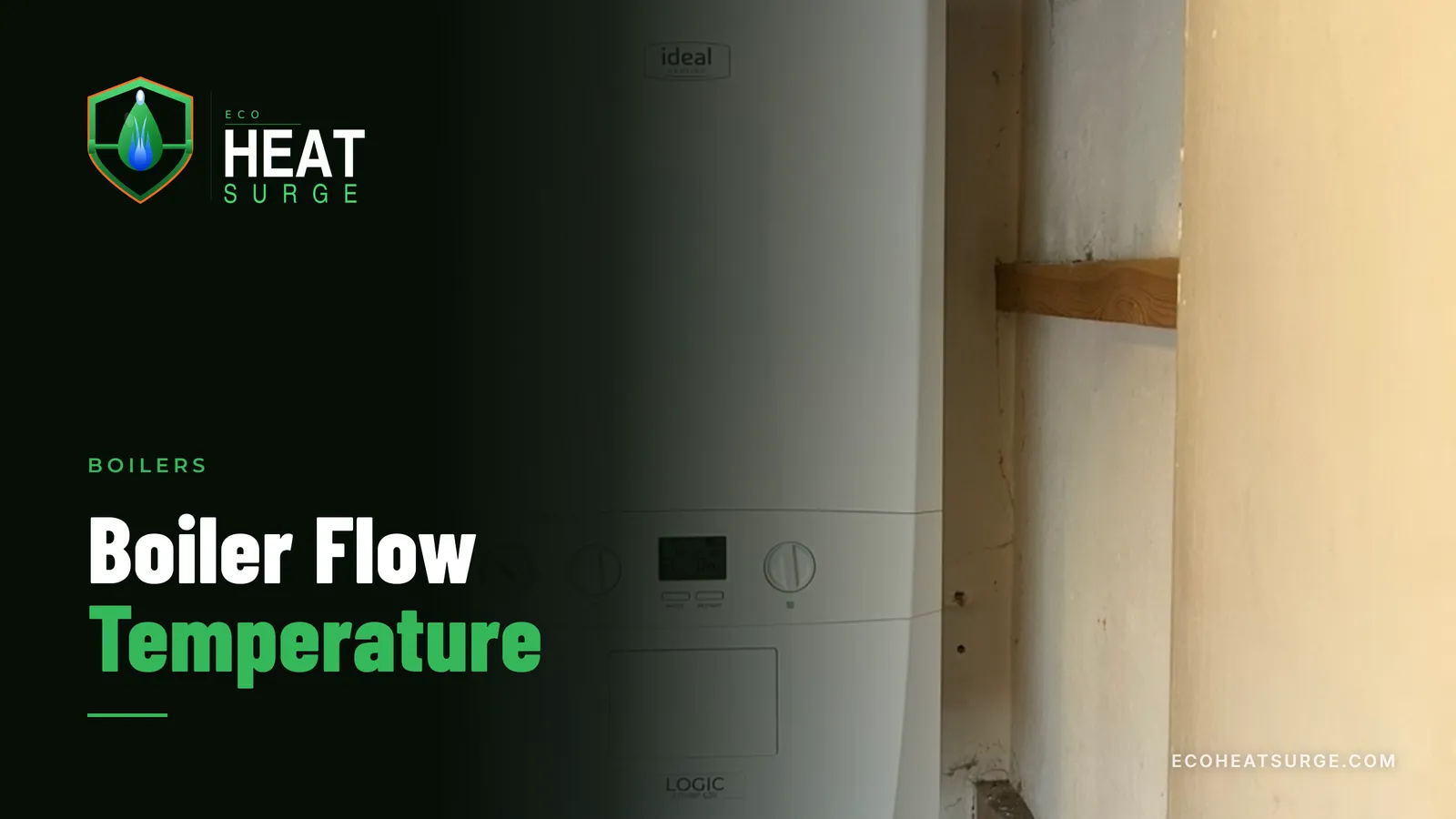
Have a look at the dial on your combi with the little radiator symbol beside it. If it's turned up near the top, your boiler's probably sending water round a lot hotter than your house needs, and you're paying for it. That setting is your boiler flow temperature, and on most combi boilers you can bring it down to around 60°C on your own, with no tools and no engineer, in less time than it takes to read this page.
Nesta, the charity behind the Money Saving Boiler Challenge, says most boilers in the UK are set well above 60°C, often at 70°C to 80°C, which is too hot for them to work at their best. I've been in the trade twelve years, plumbing first and then gas, and if you've got a combi, I'd check this dial before you spend a penny on anything else to cut your gas bill.
What flow temperature means
Your boiler heats water and pumps it round to the radiators, and how hot that water is when it leaves the boiler is your flow temperature. On its way round the house it hands its heat over to your rooms, so by the time it gets back to the boiler it's cooler, and that's what we call the return.
The return is the number that matters for your gas bill. Modern boilers are condensing boilers, built to pull extra heat out of their own exhaust by cooling it until the water vapour in it turns back into liquid. (That liquid runs away down the plastic condensate pipe, which often goes outside.) Nesta puts the cut-off at a return of roughly 54°C. The hotter the water goes out, the warmer it tends to come back, so the boiler spends less of its time condensing. Your house still warms up, but more of the heat you've paid for goes out of the flue.
Bring the flow down to 60°C and the return usually drops low enough for the boiler to condense far more of the time, which is how it was meant to run all along.
How much it might save you
The Money Saving Boiler Challenge has done the sums for an average home using about 7,400 kWh of gas a year. Going from 75°C down to 60°C cuts that home's gas use by about 10%, which they put at £57 a year on the Ofgem price cap for October to December 2026. A bigger house burning more gas saves more, and for a home using 14,000 kWh their figure is £82.
It isn't life-changing money, but it costs you nothing and you get it back every year.
Which number to pick
For a combi boiler, 60°C is a sensible place to start, and it's the figure Nesta recommends. Plenty of homes will run happily lower than that. The Heating Hub's rule of thumb is that most older houses are fine at 60°C, while newer ones (roughly anything built after 2010) can usually go down to 50 or 55°C.
| Your home | Where to start | Worth knowing |
|---|---|---|
| Older house with its original radiators | 60°C | Go up 5°C if rooms struggle in a cold snap |
| Built after about 2010, well insulated | 50 to 55°C | Often comfortable lower still in spring and autumn |
| Someone at home who feels the cold or isn't well | A little above 60°C | Make sure someone in the house knows how to turn it back up |
| Hot water cylinder in the airing cupboard | Talk to an engineer first | See the cylinder section further down |
Use the table as a starting point. Houses hold their heat in different ways and your radiators might be a bit big or a bit small for the room, which is why it's worth living with a setting for a few days before you decide.
How to turn your boiler flow temperature down on a combi
Most combis have two temperature controls on the front, a heating one and a hot water one, and the heating one usually has a little radiator symbol beside it. Some are dials, some are up and down buttons with a number on a small screen, and on a few you have to dig into a menu.
- Find the control with the radiator symbol (the one with a tap symbol is your hot water).
- Turn it down, or press the down button, until the screen reads 60°C. If your dial has no numbers on it, the boiler's manual will tell you which position is which.
- Leave the hot water setting alone.
- Live with it for a few days before you decide whether it's working.
If the controls are a mystery, find the GC number on the boiler's data badge and search for your manual online with it. That'll show you which button does what.
The setting you're changing was put there by the manufacturer for you to use. You're not taking the casing off or getting anywhere close to the gas side, which only a Gas Safe registered engineer should ever work on.
What you'll notice afterwards
Straight away, the radiators will feel warm rather than hot, which can be a bit unnerving the first evening, but it's exactly what you want. The rooms still get to whatever your thermostat's set at. They just take a little longer, so Nesta's tip is to set the heating to come on 15 to 30 minutes earlier than it used to.
If a room still isn't warm enough after a few days, put the flow back up by 5°C and give it a few more. Keep nudging it until you land on the lowest number that keeps the house comfortable. You might find 55°C does you all year, or you might drop to 50°C in the milder months and go back to 60°C when the January frosts arrive. And if you can't get on with it at all, it goes back up in seconds.
While you're at it, have a look at the numbered heads on the side of each radiator. With a cooler flow it's tempting to wind them all up to full, but Nesta suggests leaving them around the middle, which is 3 on most valves, and not shutting any right off, because that leaves big differences in temperature from one room to the next. If one radiator stays lukewarm while the rest are fine, have a read of our guide to radiators that are cold at the top or bottom before you blame the new setting.
Got a hot water cylinder? Read this before you touch anything
Everything above is about combi boilers, which heat your tap water as you use it. If you've got a system or regular boiler with a hot water cylinder, things are different.
Water that sits in a cylinder has to get hot enough to kill legionella bacteria, and the HSE says stored hot water should be at 60°C at least. On a cylinder system, the boiler is usually heating the tank as well as the radiators, so turning it right down can leave you with a cylinder that never gets properly hot. The Money Saving Boiler Challenge doesn't cover homes with a tank at all.
You can still run your radiators cooler with a cylinder, but the heating and the tank have to be set up together so the water in the tank stays hot enough, and I'd hand that balancing act to an engineer instead of guessing. If you've got a combi, nothing's stored, so you can ignore this bit.
Will a lower setting harm the boiler?
It shouldn't. Running cool enough to condense is how a modern boiler's meant to work, so you're not pushing it anywhere it wasn't built to go. It does mean the boiler makes condensate more of the time, so it's worth knowing what to do if that pipe freezes on a hard frost. Our frozen condensate pipe article has the steps.
Where a lower setting can struggle is in a house with small, old radiators, or a system so full of sludge that the water can't move round properly. Turning the flow down doesn't cause either of those, but it can show them up, because there's less spare heat to cover for them. If you've dropped it and a room or two just won't warm up however long you give it, that's worth us coming to look at. Sometimes the answer is a bigger radiator or a system that's properly balanced, and both of those are jobs our central heating team takes on.
When to bring us in
If you're on a combi, there's nothing stopping you trying your boiler flow temperature at 60°C tonight and seeing how the week goes. If you've got a cylinder, or you'd just rather someone looked over the whole system, book your annual boiler service or get in touch and tell us what's going on, and we'll give you an honest steer.
Frequently asked questions
What should my boiler flow temperature be?
On a combi boiler, start at 60°C and live with it for a few days. If a room won't get warm, turn it up by 5°C and try again. If the house is comfortable, you can try going a little lower, and keep whichever is the lowest number that still keeps everyone warm.
Will turning down the flow temperature affect my hot water?
Not on a combi. The radiator setting and the hot water setting are separate controls, so you only change the one with the radiator symbol. If you have a hot water cylinder, it's different: the stored water needs to reach 60°C, so talk to an engineer before you lower anything.
Is this the same as turning my thermostat down?
No. The thermostat decides how warm the room gets before the heating switches off. The flow temperature decides how hot the water in the radiators is on its way there. You can lower the flow and leave your thermostat exactly where you like it, so the house ends up just as warm.
Do I need to change it again in summer?
On a combi, no. With the heating off, the radiator setting isn't doing anything, and your hot water has its own control. The Money Saving Boiler Challenge does say you can go a bit lower in spring and early autumn, then back up in the colder months, if you fancy fine-tuning it.
Get more like this
One honest email a month.
Boiler tips, heat pump advice, and answers to the questions our customers actually ask.