
Most boilers that let people down do it in November. There is nothing special about the month. It is simply the first time in the year the boiler runs hard for hours every day after a long summer of mostly heating water, so anything that has drifted out of spec since spring shows itself the moment real demand arrives.
That is what an annual service is for, and it is why the best time to book one is before October, not after the first cold snap.
The short answer: an annual boiler service with us is £80 including VAT and takes 60 to 90 minutes. It covers 14 checks in three groups: combustion and gas, the internal components, and the controls and safety devices. You get a written service record and a dated sticker on the boiler before we leave, and the work is done by a Gas Safe engineer you can look up on the Gas Safe Register.
I'm Adam, co-founder of Eco Heat Surge, with 23 years on the tools. Below is exactly what those 14 checks involve, the extra system checks we run while we are there, and what we tend to flag.
The 14 checks at a glance
| Group | What we check |
|---|---|
| Combustion and gas | Flue gas analysis, gas inlet and burner pressure, combustion seal, flue and terminal |
| Internal components | Heat exchanger, burner and injectors, fan, condensate trap and pipework |
| Controls and safety | Pressure relief valve, expansion vessel, thermostat and timer, carbon monoxide, external pipework and isolation valves, your service record |
Combustion and gas
1. Flue gas analysis
An analyser probe goes into the flue and takes two readings: the amount of carbon monoxide leaving the boiler, and the ratio of carbon monoxide to carbon dioxide. Between them they show how cleanly the gas is burning. Each reading is compared against the manufacturer's figures for your model and written on the service record, so you have proof it was measured rather than guessed.
2. Gas inlet and burner pressure
With a manometer we check the gas reaching the boiler is at the right pressure, both standing and with the boiler firing. If it is low, the boiler cannot burn properly, and we trace the cause: the meter regulator, undersized pipework, or a valve left half closed at the back of a kitchen cupboard. We also time the gas rate against the manufacturer's specification, because a boiler that over-fires wastes gas and one that under-fires burns dirty.
3. Combustion seal
The combustion chamber is a sealed box, and it has to stay that way so fumes leave through the flue instead of drifting into your room. We check the case seals and gaskets are intact and seated properly, and flag any that have perished.
4. Flue and terminal
Before we open anything, we look at the outside of the job. Soot marks, water staining, discoloured flue pipe and a corroded terminal all tell a story. We check the flue is supported, sealed at every joint and clear at the outlet. Most of the boilers we ever have to switch off for safety reasons fail right here, before a single panel comes off.
Internal components
5. Heat exchanger
With the case off, we inspect the heat exchanger for soot (a sign of poor combustion), white scale carried over from hard water, corrosion and cracks, and clean it where it needs it. Soot brushes away. A crack means the boiler has reached the end of its working life, and we'll tell you straight instead of bodging it.
6. Burner and injectors
The burner comes out, gets cleaned and goes back in. On older boilers the ports clog with combustion debris and the flame suffers, and a few minutes with a brush shows up straight away as better readings when we re-test.
7. Fan
The fan pushes combustion gases out through the flue, so we check it starts cleanly, runs at the right speed and is not noisy or sluggish. A tired fan is one of those parts that quietly gets worse until the day the boiler locks out.
8. Condensate trap and pipework
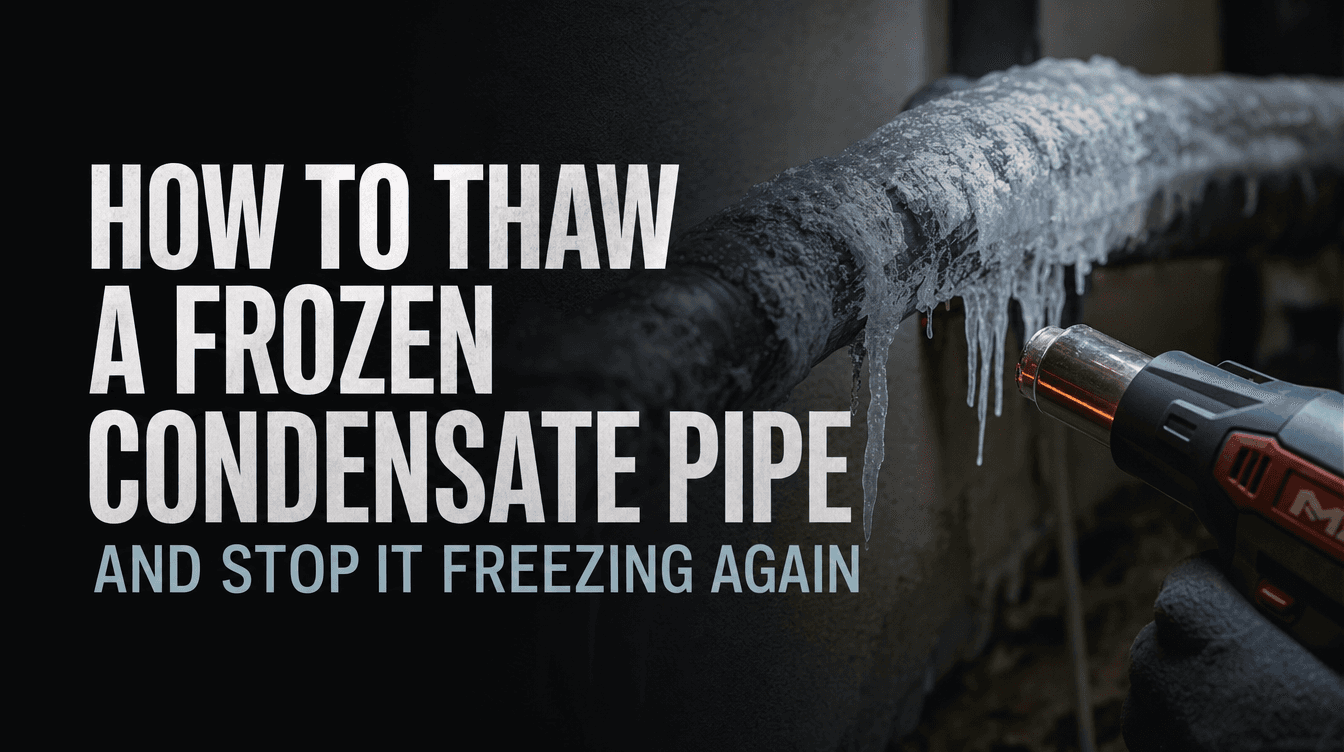
A condensing boiler produces slightly acidic water that drains away through a trap and a condensate pipe. We empty, flush and refill the trap, then check the pipe runs freely with a proper fall. A condensate pipe freezing on a cold outside wall is a classic cause of a boiler stopping in January, so if yours is exposed we will point it out.
Controls and safety
9. Pressure relief valve
This valve lets water out if the system pressure climbs too high. We test it, and if it keeps dripping afterwards it needs replacing before it sticks open and empties your system pressure.
10. Expansion vessel
Inside the boiler, a pressurised vessel soaks up the extra volume of water as it heats. Its diaphragm wears over time, usually after six to eight years. We check the charge against the manufacturer's figure and top it up if it has dropped. Pressure that keeps falling, or jumps when the heating comes on, often leads back here.
11. Thermostat and timer
We check the room thermostat reads accurately, that the boiler responds when it calls for heat, and the timer or programmer switches on and off when you asked it to. If you have a smart thermostat, we make sure it is still talking to the boiler reliably.
12. Carbon monoxide
Alongside the flue readings, we check for carbon monoxide around the appliance itself. CO has no smell and no colour, which is exactly why it is measured every year instead of assumed. A service checks the boiler on the day; an audible CO alarm near your gas appliances protects you for the other 364.
13. External pipework and isolation valves
We look over the visible gas and water pipework around the boiler and check the isolation valves turn and shut off as they should, so the boiler can be isolated quickly if it ever needs to be.
14. Your service record
Everything we have tested is written up. You get the record by email and a dated sticker on the boiler. Boiler makers, Ideal included, only honour their warranties when there is proof of a yearly service, so this is the piece of paper to keep.
The system checks we do while we are there
The boiler is only half of your heating. While we are on site we also:
- Open the magnetic filter if you have one. How much black sludge it has caught tells us how the system is wearing inside.
- Listen to the pump under load. Worn bearings sound different long before they give up.
- Test the diverter valve on a combi by running the heating and then a hot tap. A sticking diverter is the usual reason for a lukewarm shower while the heating is on.
- Walk round the radiators. Cold at the top means air that needs bleeding. Cold at the bottom usually means sludge.
What we would flag before it turns into a callout
Most of our visits end with a record that says all good, see you next year. When we do find something, it is usually one of these, and we will tell you whether it is urgent or fine for another twelve months:
- Heavy sludge in the filter. Cleaning the system now protects the pump and heat exchanger later.
- A low expansion vessel. Re-charge it now, or plan to replace it within the year.
- System pressure dropping between visits. There is a small leak somewhere, and it is far cheaper to find while it is small.
- A dripping pressure relief valve. Better replaced before it sticks open.
- A condensate pipe in a frost-prone spot. Worth insulating or rerouting before December.
Small adjustments made during the service are part of the £80. Anything bigger gets a fixed price in writing first, and nothing goes ahead without your say-so.
Why book before October?
There are three good reasons to have the service done before the heating season starts.
- Faults turn up while you can live without the heating. A worn part spotted in September can be ordered and fitted on a day that suits you. The same part failing in November means a chilly few days waiting for it to arrive.
- Slots are easier to get. Once the first cold snap arrives in October the phones fill with breakdowns, and from November to March routine visits get fitted in around them.
- The boiler goes into winter checked and clean. It is about to work hard for months, so it makes sense for the readings and settings to be right before that starts, not halfway through.
Booking a service in Barnsley and across South Yorkshire
The service is the same £80 wherever you are. We look after boilers right across Barnsley from our base in Tankersley, over into Rotherham, and throughout the rest of South Yorkshire. If you want the pricing side in more detail, our guide to what a boiler service costs in Barnsley covers it, and if your boiler has already stopped working, head straight to boiler repair.
Landlords can have the service and a CP12 done in the same visit for £150 per property, which is covered on our gas safety check page.
Ready to book? Our annual boiler servicing page has the details, or contact us to grab a slot ahead of the rush.
Frequently asked questions
What is included in an annual boiler service?
Our annual service is 14 checks in three groups. We analyse the flue gases, test gas pressure and the combustion seal, look inside at the heat exchanger, burner, fan and condensate trap, cleaning as we go, and test the pressure relief valve, expansion vessel, controls and carbon monoxide. You finish with a written service record.
When is the best time to book a boiler service?
Before October. Any fault we find can then be fixed on a day that suits you, while you can still manage without the heating. Once the first cold snap arrives, engineers are busy with breakdowns and routine visits get squeezed in around them until spring.
What happens if the engineer finds a fault?
You hear about it on the spot, in plain English, along with whether it is urgent or can wait. Small adjustments are included in the £80. Anything bigger is priced in writing before we touch it, and if something we find is dangerous, we deal with it under Gas Safe rules and talk you through what happens next.
Do I still need a carbon monoxide alarm if my boiler is serviced?
Yes. A service confirms the boiler is burning safely on the day we visit, but faults can develop at any point during the year. An audible carbon monoxide alarm near your gas appliances gives you a warning between services, and it costs very little for the protection it offers.
Can you service a boiler you did not install?
Yes. We service every major make whatever its age, from Baxi, Vokera and Ferroli through to Ideal, Potterton, Main and Alpha. If the boiler is still inside its manufacturer warranty, an annual service with a Gas Safe engineer is what keeps that cover in place.
Get more like this
One honest email a month.
Boiler tips, heat pump advice, and answers to the questions our customers actually ask.